










I. Definition and Business Value of AI Product Description Generation
AI product description generation is the capability to use generative models, structured product data, and predefined writing rules to organize product names, materials, specifications, functions, applications, and service information into publishable copy. It serves product detail pages, category pages, advertising landing pages, catalogs, and multilingual pages, rather than simply replacing human writing.
In B2B procurement, descriptions help buyers screen suppliers, understand technical compatibility, and communicate before submitting an inquiry. Effective content should answer what the product is, which operating conditions it is suitable for, how parameters are confirmed, and what customization or delivery support can be provided, avoiding generic selling points without a procurement basis.
For companies with numerous models, specifications, or multilingual markets, AI product description generation can shorten the initial drafting cycle, allowing operations personnel to focus on parameter verification, differentiated selling points, and conversion path optimization. Its value comes from improved content coverage and consistency, while accuracy and verifiable information must remain the ultimate boundaries.
II. Technical Principles and Content Quality Control
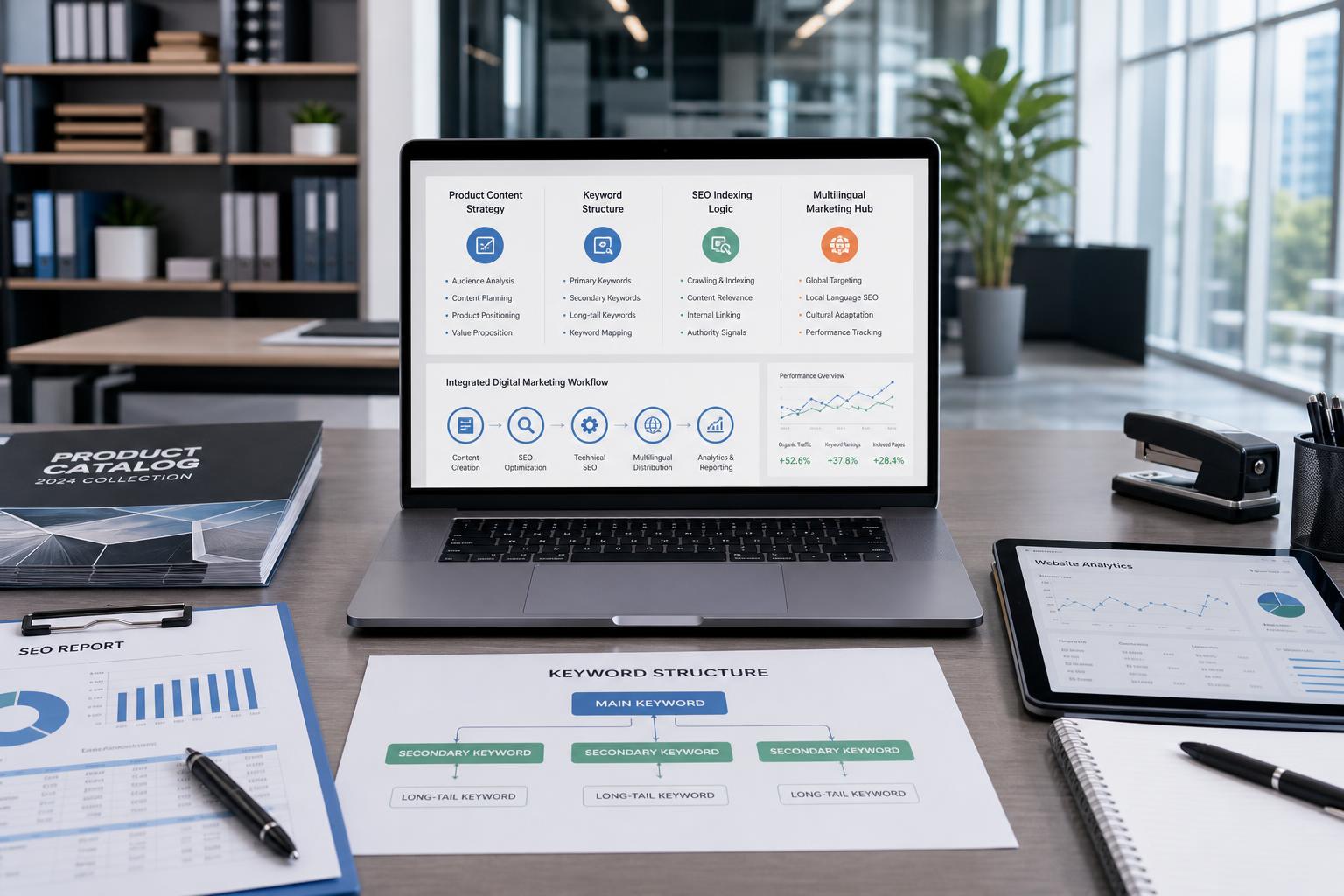
The system typically first reads fields in the product database, such as model, dimensions, power, raw materials, process, packaging, minimum order requirements, and application industries; it then generates titles, summaries, selling points, parameter descriptions, and FAQs according to page templates. Field completeness determines the upper limit of output quality, and vague input does not automatically become reliable technical facts.
More mature AI product description generation workflows incorporate constraints such as keyword intent, language habits in target countries, page hierarchy, and prohibited wording, enabling different models to maintain a consistent structure while retaining their actual differences. For specialized categories such as machinery, chemicals, and new energy, specification sheets and body copy should be maintained separately to reduce the risk of mismatches.
Quality control should include manual review checkpoints: business or engineering personnel confirm technical parameters, foreign trade personnel verify trade terms and lead-time wording, and operations personnel check duplicate content, internal links, and inquiry entry points. For performance, compliance, certification, or test conclusions, only information that has been confirmed by the company and can be substantiated may be cited.
III. Main Types and Applicable Users
By generation objective, common types include single-product detail descriptions, bulk model descriptions, category page introductions, cross-border retail selling-point copy, multilingual localized versions, and Q&A content written around procurement questions. Companies should select templates based on page responsibilities and should not use the same promotional paragraph for all products.
Manufacturing plants and OEM or ODM suppliers are suited to parameter-driven descriptions that highlight production capacity, customization scope, and application conditions; trading companies need to supplement information on combined procurement, delivery coordination, and product selection assistance; DTC brands should also address user experience, specification selection, and purchase decision information.
Yingyingbao provides AI-powered website building and content generation capabilities for foreign trade companies, manufacturers, and cross-border sellers, enabling products, articles, and multilingual sites to be managed within the same system. For teams with extensive product lines and limited maintenance staff, this integrated approach helps reduce scattered information and duplicate data entry.
IV. Selection Criteria and Website Integration Essentials
When procuring an AI product description generation tool, first check whether it supports structured fields, bulk editing, version retention, and manual publishing approval. Tools that only allow a single prompt are suitable for idea assistance, but they are difficult to use reliably for the ongoing operation of hundreds of models and do not facilitate accountability tracing.
Next, assess whether content can be directly entered into the website product database and linked with categories, images, specification sheets, downloadable materials, inquiry forms, and related recommendations. After publication, it should also be possible to view indexing, visits, dwell time, and inquiry sources; otherwise, the team cannot determine which content truly generates high-quality business opportunities.
Multilingual projects should also focus on the relationship among language paths, regional pages, and language versions. Yingyingbao provides multilingual website building and AI-assisted translation capabilities in English, Japanese, German, French, Spanish, and other languages. It is suitable for validating content in key markets first and then gradually expanding languages, avoiding a broad rollout without personnel available for review.
V. B2B Application Scenarios and Page Writing
For categories such as laser engraving machines, heavy-duty truck parts, steel, chemicals, and machinery, product pages should prioritize the models, key parameters, compatible equipment, operating environments, customization options, and inquiry information that buyers care about. AI product description generation can create initial drafts based on fields, but the differentiated parameters of each model must be clearly presented.
Yingyingbao serves industries including machinery, new energy, automotive, agriculture, healthcare, and furniture, and has also served companies such as Haier, Aucma, Shandong Airlines, Yuanhe Power Station, Little Duck Group, and China National Heavy Duty Truck Group. Specific projects should be based on customers' publicly available information and the scope confirmed by both parties; industry experience should not be directly applied as a promise for a single product.
In practice, a structure of “core use + specification evidence + application scenario + procurement action” can be adopted: the opening paragraph explains product positioning, the middle section provides verifiable parameters and optional configurations, and the final section explains access points for samples, quotations, drawings, or technical consultation. This both facilitates buyer scanning and enables sales teams to obtain more complete requirement information.
VI. Maintenance Cycles, Organic Traffic, and Future Trends
Product information does not remain valid permanently after a single publication. When a model is discontinued, materials are replaced, processes are upgraded, lead times change, or target markets are adjusted, pages should be updated accordingly. It is recommended to review key products quarterly, while pages with advertising activity or concentrated inquiries can be reviewed monthly to ensure web information remains consistent with sales materials.
Organic search growth depends on continually improving topic coverage rather than publishing similar paragraphs in bulk. Companies can add content around product selection, installation and maintenance, application industries, common faults, and procurement questions, and reasonably link articles to product pages. AI product description generation is suitable for improving production efficiency, but content strategy and review mechanisms remain indispensable.
In the future, search and Q&A environments will place greater emphasis on entity information, clearly structured knowledge content, and multilingual consistency. Yingyingbao already provides AI plus GEO operational capabilities, helping companies accumulate company introductions, solutions, Q&A, and product knowledge; results should be continuously evaluated through visibility, visit quality, and qualified inquiries.
VII. Total Cost of Ownership and Return on Investment Assessment
The total cost of ownership for AI product description generation includes not only software subscriptions, but also product information organization, template design, multilingual review, image and parameter maintenance, staff training, and ongoing operations. Before procurement, companies should assess the number of SKUs, number of languages, update frequency, and existing content quality to avoid underestimating subsequent management work.
Returns should not be measured solely by the number of pieces generated. More important indicators include launch speed, effective page coverage, organic traffic growth, advertising landing-page conversion, inquiry completeness, and sales follow-up efficiency. For high-ticket industrial products, a small number of better-matched inquiries often has greater commercial value than a large volume of irrelevant traffic.
It is recommended to first select one key category for a trial run, establish field standards and a review checklist, and then compare data before and after publication. Yingyingbao connects website building, AI content, search optimization, advertising, and website operations into a closed loop. Companies can select modules according to their own team capabilities and gradually build maintainable overseas digital assets.
