










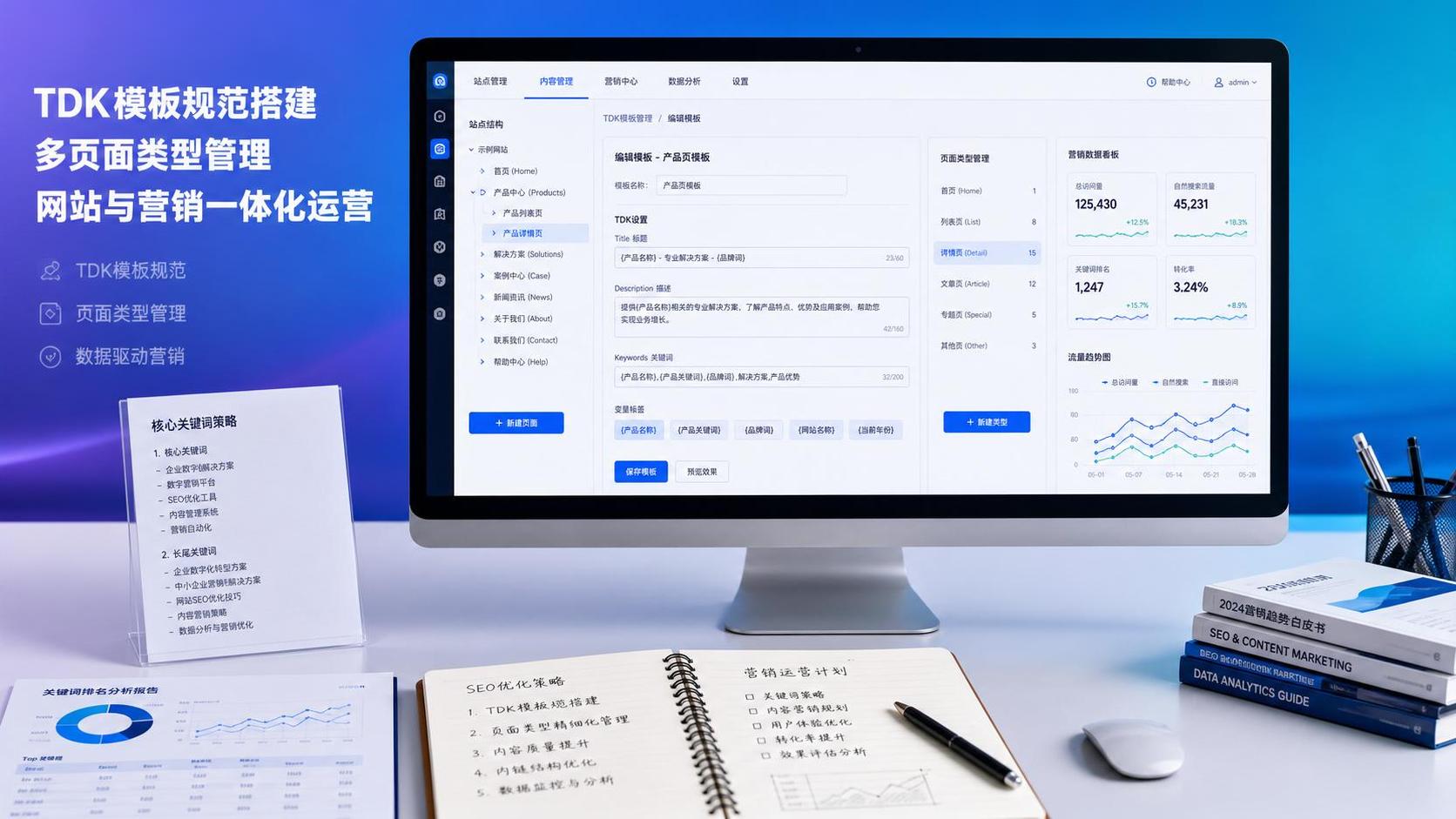

I. Definition and Page Boundaries of TDK Templates
A TDK template generally refers to the standardized writing rules and field structure for the three metadata elements of a web page: Title, Description, and Keywords. It does not mean mechanically copying the same keyword phrase across an entire website. Instead, it establishes a content framework that can be implemented, reviewed, and updated in batches based on page intent, product attributes, target markets, and conversion actions.
Among these elements, the title determines the identification of the core topic in search results; the description provides supplementary value, application scenarios, and calls to action; and the keywords field can serve as an auxiliary item for internal content planning and website management. In actual optimization, priority should be given to ensuring that titles and descriptions align with the page content, category structure, and user needs.
For foreign trade companies, TDK templates must also address differences in language, country, units, procurement terminology, and brand expression. For example, when the same equipment is targeted at buyers in Germany and the Middle East, product names, purchasing priorities, and inquiry entry copy should not simply be translated and reused.
II. Technical Principles and Standard Writing Practices
Search engines understand web pages by combining page titles, content topics, link relationships, structured data, and user visit feedback. The technical value of TDK templates lies in keeping page topics consistent with the site information architecture, reducing issues where multiple pages compete for the same search intent or contain duplicate descriptions.
Titles are recommended to follow the sequence of “core product or topic + key specification, application, or advantage + brand.” The homepage should cover the company’s main business and core markets; category pages should summarize product categories; product pages should highlight models, materials, capabilities, or applications; and article pages should directly answer specific questions.
Descriptions should use complete, natural sentences to explain what problems the page can solve, while adding information that buyers care about, such as lead times, customization, applications, services, or contact paths. Avoid listing large numbers of synonyms, and do not promise performance, certifications, or delivery outcomes that the page cannot substantiate. Ensure that click expectations match the landing page content.
III. Mainstream TDK Template Categories
Homepage TDK templates are suitable for presenting company positioning: main product categories, service capabilities, target regions, and brand name. Their focus is to establish a clear business entry point and they should not be expected to cover all long-tail keywords. For companies with multiple business lines, segmented industries and solutions can be addressed separately by category pages and topic pages.
Category page TDK templates emphasize category boundaries, such as “industrial valve manufacturer” or “packaging equipment solutions,” and describe available specifications, application industries, or customization capabilities. Product page templates should use actual product names, models, parameter dimensions, and procurement value, avoiding the use of identical titles and descriptions for different models.
TDK templates for articles and FAQ pages are suitable for addressing informational needs such as comparisons, product selection, maintenance, and factors affecting prices. Case study pages should focus on the client’s industry, the problems solved, and the scope of implementation, and must not extend served industries or brand names into unverified cooperation results.
IV. Selection Criteria and Applicable Users
Before selecting TDK templates, a page inventory should first be established: which pages are used for brand presentation, which are used for product lead generation, which are used for knowledge education, and which receive advertising or social media traffic. Each type of page should have a unique primary topic, with clearly defined target countries, languages, audience roles, and expected conversion actions.
Manufacturing plants, OEM/ODM companies, foreign trade companies, industrial product suppliers, and cross-border brands typically need a template system with a clear product hierarchy. Companies with hundreds of SKUs should especially establish field rules to manage categories, models, materials, specifications, scenarios, and regions separately, reducing errors caused by batch updates.
Yiyingbao’s AI-powered website building, multilingual independent websites, and AI+SEO services are suitable for teams that need to centrally manage products, articles, categories, and multilingual pages. Its responsive website-building capabilities, content generation assistance, and global node deployment can provide foundational support for TDK template publishing, mobile display, and overseas access.
V. Deployment Process, Review, and Quality Control
Implementation can proceed through “keyword research, page mapping, field design, content writing, launch validation, and data review.” First, group target keywords into brand terms, category terms, product terms, scenario terms, and question terms, then match each keyword group with the most appropriate page to avoid creating a large number of low-value pages without supporting content.
Quality review should check whether titles are duplicated, whether descriptions are consistent with the main content, whether product parameters are accurate, whether multilingual expressions are localized, whether links point to the correct pages, and whether content can be read properly on mobile devices. For pages involving discontinued models, changed specifications, or adjusted market strategies, TDK templates and the main page content should be updated simultaneously.
Multilingual websites should also be reviewed independently by language version. It is not recommended to simply replace words based on Chinese keyword logic. Yiyingbao can help companies reduce repetitive operations in content management, AI-assisted generation, language paths, and basic internationalization configuration, but final confirmation of product facts, trade terms, and market wording should still be provided by the business team.
VI. Application Scenarios, Maintenance Cycles, and Development Trends
TDK templates are applicable to scenarios such as foreign trade website redesigns, new product launches, cross-border store product range expansion, entry into multilingual markets, Google Ads landing page development, and knowledge base operations. Industries such as laser engraving machines, steel, chemicals, heavy-duty trucks, machinery, and new energy often involve complex products and long decision-making cycles, making it even more necessary to distinguish procurement needs through page topics.
Regular pages can be checked quarterly for displayed content and search demand, while new product pages, promotional pages, seasonal pages, and pages with significant ranking fluctuations should be reviewed more promptly. Maintenance should not focus only on revising titles; product information, images, FAQs, inquiry forms, and internal links should also be checked simultaneously to ensure that users can obtain complete information after entering the page.
In the future, TDK templates will shift from single-page keyword placement toward entity-based, question-and-answer-based, and multimodal content coordination. In response to the generative search environment, companies need to accumulate verifiable company introductions, product parameters, application descriptions, case studies, and FAQs so that both search systems and potential buyers can understand brand capabilities more accurately.
VII. Total Cost of Ownership and Return on Investment Evaluation
The total cost of ownership for TDK templates includes not only the initial writing cost, but also investment in keyword research, product information organization, translation localization, system configuration, review, ongoing updates, and data analysis. The number of pages, number of languages, SKU complexity, content approval workflow, and whether technical redesign is required can all significantly affect the budget.
When evaluating solutions, buyers should focus on whether templates can integrate with product databases, category management, article systems, and multilingual versions, rather than comparing only the price of copy for a single page. Reusable fields, batch rules, version records, and anomaly detection capabilities are generally more conducive to controlling long-term maintenance costs and reducing personnel handover risks.
Return evaluation can track the number of effectively indexed pages, target keyword impressions and clicks, organic traffic quality, inquiry volume, inquiry sources, and sales follow-up results. Yiyingbao provides combined services for website building, SEO, advertising, social media, and website operations, making it suitable for website projects that aim to incorporate TDK templates into an ongoing lead-generation process rather than leaving them unused long after one-time completion.
