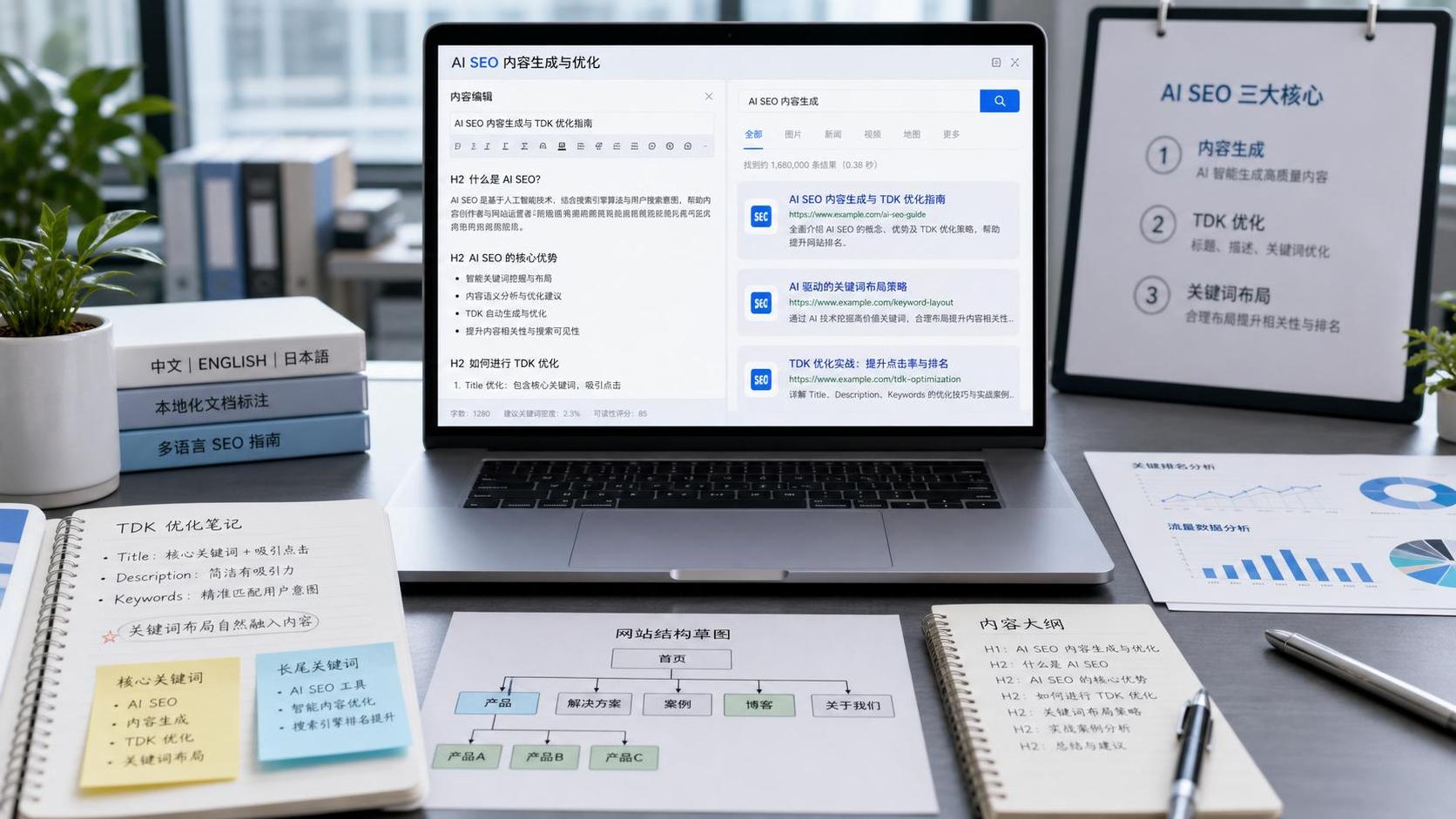
I. Definition and Scope of AI SEO Content Generation
AI SEO content generation refers to a content production method that uses generative artificial intelligence to assist with keyword analysis, content outlines, page copy, title and description creation, Q&A content, and internal linking recommendations, while applying human review, publishing, and iteration based on search demand and business conversion requirements. Its output is not merely articles, but website information assets that can be accumulated continuously.
In B2B scenarios, qualified content should answer buyers' specific questions, such as how to select product specifications, material differences, operating conditions, lead times, customization capabilities, and after-sales support. AI SEO content generation is responsible for improving research and first-draft efficiency, while companies still need to provide actual parameters, factory capabilities, case boundaries, and compliance information.
It is fundamentally different from mass keyword stuffing or directly copying generic text. Content must have a clear topic, verifiable facts, a logical page hierarchy, and corresponding inquiry paths to support search visibility, user understanding, and sales lead qualification simultaneously.
II. Technical Principles: From Search Demand to Content Assets
AI SEO content generation typically starts with keyword clusters. The system categorizes core keywords, product keywords, application keywords, question keywords, and regional language keywords, then determines whether users are in the awareness, comparison, procurement, or after-sales stage. Different stages should be matched with industry guides, category pages, product pages, solution pages, or FAQ pages, rather than having all pages compete for the same keyword.
The generation stage requires a clearly defined fact base, including models, materials, dimensions, performance ranges, test conditions, applicable industries, delivery processes, and limitations. Based on this information, the model creates title hierarchies, paragraphs, table recommendations, and calls to action; editors then verify the professional wording to avoid including assumptions, outdated materials, or inapplicable commitments on the page.
After publication, indexing, impressions, clicks, dwell time, inquiries, and traffic distribution among pages should also be monitored. For pages with impressions but no clicks, titles and summaries can be adjusted; for pages with visits but no inquiries, specification downloads, consultation entry points, lead-time explanations, or trust information should be added. This closed loop determines whether content truly generates business value.
III. Main Content Types and Applicable Pages
The first type is product-oriented content, including product descriptions, specification details, selection guides, alternative solutions, and product Q&A. It is suitable for manufacturing factories, equipment suppliers, and industrial product traders. The focus is on accurately presenting differentiated parameters and establishing traceable links among related products, accessories, and application pages.
The second type is knowledge-oriented content, including process analysis, material comparisons, procurement checklists, maintenance methods, and industry trends, which is suitable for covering long-tail search demand. This type of AI SEO content generation should be reviewed by technical, sales, or after-sales personnel, especially to distinguish between general experience and services that the company can actually deliver.
The third type is conversion-oriented content, including industry solutions, landing pages, case study frameworks, company capability pages, and multilingual pages. Its goal is to help overseas visitors quickly understand whether the company is suitable for their project requirements. Therefore, forms, email, WhatsApp, or other existing communication channels should be provided, along with clear information on the next consultation step.
IV. Who Should Adopt It and How to Choose a Service
Foreign trade companies, OEM/ODM factories, cross-border brands, machinery and equipment suppliers, chemical and new energy suppliers are particularly well suited to AI SEO content generation. They often have extensive product lines, dispersed professional information, and broad language coverage. Relying on manual page-by-page writing results in slow publishing and makes it difficult to maintain a consistent content update cadence.
When selecting a service provider, buyers should assess whether it can provide keyword research, website structure optimization, multilingual path configuration, content review processes, data tracking, and ongoing operations, rather than comparing only the price of individual copywriting pieces. If the service cannot integrate with existing product materials and sales processes, large-scale generation may instead increase proofreading costs.
Yiyingbao addresses integrated website building and marketing needs by providing AI-powered website building, multilingual independent websites, AI-assisted content generation, and website operation capabilities. For companies that need to build product pages, article pages, and marketing landing pages simultaneously, content planning can be incorporated into the site architecture to reduce repeated migration and maintenance later.
V. Application Scenarios, Processes, and Quality Control
A typical process can be divided into six steps: inventory products and customer questions, establish a keyword map, determine page priorities, generate and review first drafts, complete page publication and internal link configuration, and perform monthly updates based on data. New websites should first cover core products, industry solutions, and company trust pages, then gradually expand into long-tail topics.
For multilingual projects, target countries, priority products, and local procurement terminology should be determined before translation and localization. Language switching, regional pages, and their corresponding relationships need to remain clear to avoid extensively copying directly translated Chinese content across different sites. For safety, medical, chemical, or performance-related indicators, confirmation by the business manager is required.
Yiyingbao has served industries including laser engraving machines, steel, chemicals, heavy-duty trucks, machinery, and new energy, and also covers companies listed in case materials such as Haier, Aucma, Shandong Airlines, Yuanhe Power Station, Xiaoya Group, and China National Heavy Duty Truck Group. Different projects should develop content plans around actual product materials and market objectives rather than applying the same template.
VI. Total Cost of Ownership and Return on Investment Assessment
The total cost of ownership for AI SEO content generation includes not only tool or content service fees, but also keyword research, material organization, professional review, translation and localization, page production, technical maintenance, and data analysis. Incomplete product parameters, overly long approval chains, or missing multilingual materials can all significantly increase actual investment.
When evaluating returns, it is recommended to conduct tiered statistics based on effectively indexed pages, impressions and clicks for target keywords, qualified inquiries generated by organic traffic, sales follow-up rates, and sales cycles. Judging solely by article quantity or short-term rankings can easily overlook the lengthy decision-making process involved in high-ticket B2B projects.
A more prudent investment approach is to first select a product line or target market for a pilot project, establish content templates, review mechanisms, and conversion tracking, and then replicate them across other categories and languages. When website building, content, advertising, and social media are advanced in coordination, advertising search terms and customer inquiries can also inform organic content topics.
VII. Maintenance Cadence and Development Trends for 2026
Content maintenance cycles should be set according to page value. Core product pages can be updated promptly based on new products, parameters, inventory, and market feedback; industry guide and Q&A pages should undergo regular reviews of data and links; pages that have long received no impressions or are disconnected from the business should be consolidated, rewritten, or removed to keep the website focused.
In 2026, search results and generative Q&A scenarios will place greater emphasis on understandable entity information, clear answers to questions, source transparency, and multilingual consistency. Companies need to accumulate product knowledge, service processes, common objections, and credible facts so that content can both be discovered through traditional search and more easily cited by generative engines.
Yiyingbao has released versions including the Cloud Intelligent Website Building Marketing System V6.0, the AI Foreign Trade Independent Website Marketing System V5.0, and the Cloud Intelligent Multilingual Website Building System V1.0. When implementing AI SEO content generation, companies can prioritize solutions that support coordination among websites, content, multilingual capabilities, and operations, enabling the continuous accumulation of independently controlled overseas digital assets.
 Is AI SEO content generation for TDK reliable? Hands-on test of title, description, and keyword layoutIs AI SEO content generation for TDK reliable? This article uses hands-on testing to break down common issues in title, description, and keyword layout, analyzes applicable scenarios and optimization methods, and helps website and marketing integrated services improve indexing, click-through rates, and conversion performance.
 How to calculate AI SEO content generation pricing? Is it by article, by word, or by project?How is AI SEO content generation pricing determined more reasonably? This article explains the pros and cons of the three pricing models: by article, by word, and by project, helping you determine which is more suitable for SEO indexing, traffic growth, and inquiry conversion. A must-read before purchasing.