









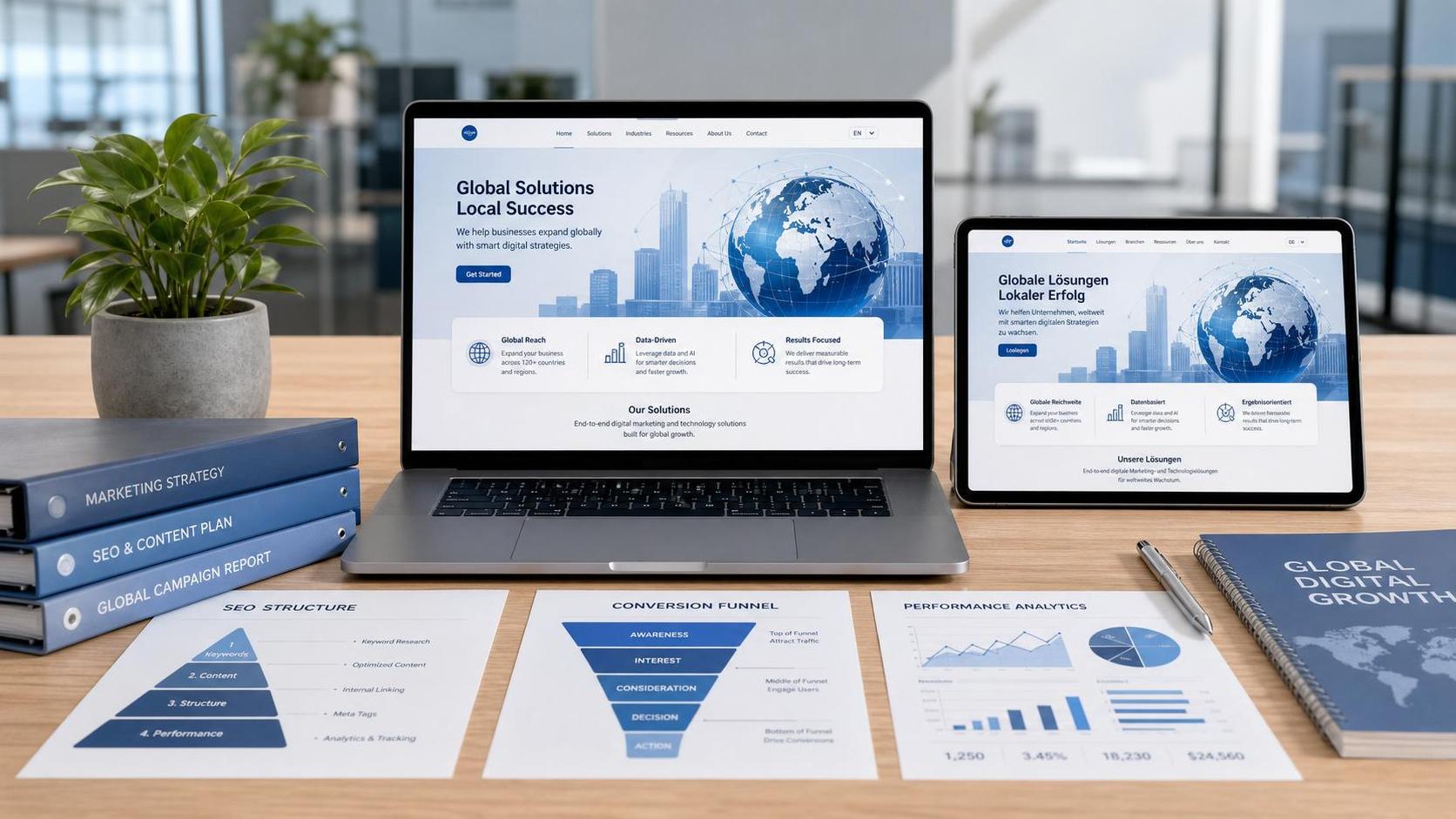
I. Definition and Decision-Making Value of AI Website Building Demonstrations
An AI website building demonstration is a process in which a service provider uses operable pages, content generation workflows, and marketing configurations to show enterprises a website's capabilities from development through lead acquisition and conversion. Buyers should focus not only on visual effects, but also verify whether product information, brand trust, communication channels, and data tracking can work together effectively.
In foreign trade B2B scenarios, an effective AI website building demonstration should recreate the journey of overseas buyers: entering a page through search, advertising, or social media; understanding product specifications, company capabilities, and delivery terms; and then submitting an inquiry through a form, email, or instant messaging tool.
It is also a practical way to distinguish between a “showcase website” and a “marketing website.” The former focuses on company introductions, while the latter must incorporate keyword placement, content management, conversion components, website speed, and ongoing operations into a unified and verifiable business workflow.
II. Core Technical Principles and Delivery Structure
AI website building demonstrations are typically based on a SaaS website-building engine, consisting of templates, components, a content management system, and responsive pages. Enterprises can manage categories, products, articles, and landing pages in a unified backend, while ensuring that pages adapt to browsing and submission behavior on desktops, tablets, and mobile devices.
The value of generative AI lies in assisting with the creation of site structures, product descriptions, page titles, FAQs, and marketing copy, but it cannot replace business review. Technical specifications, certification scope, delivery time, applicable countries, and after-sales commitments must be supported by reliable sources provided by the enterprise and manually reviewed.
A complete delivery should also cover domain name resolution, SSL certificates, server or CDN deployment, form notifications, traffic analytics, and permission management. During the demonstration stage, the first-screen loading speed, image compression, mobile menus, form fields, and email delivery chain should be checked live, rather than merely reviewing design mockups.
III. Main Website Types and Applicable Businesses
B2B foreign trade marketing websites are suitable for manufacturing factories, OEM or ODM companies, trading companies, and industrial product suppliers. Their focus includes product catalogs, specification downloads, factory capabilities, application cases, quality processes, and inquiry channels, helping procurement personnel quickly complete initial supplier screening and communication.
B2C cross-border independent websites serve brand owners, cross-border sellers, and factories undergoing transformation. In addition to content presentation, they need to validate product attributes, prices, shopping carts, inquiry or ordering workflows, and configure landing pages aligned with advertising themes for advertising and social media traffic.
Multilingual websites are suitable for export enterprises serving multiple countries. An AI website building demonstration should show language switching, independent language paths, translated-page maintenance, and localization review methods. Different languages should not involve simply replacing text; units, currencies, market preferences, and communication practices must also be checked.
IV. Procurement Selection Criteria and the Yiyingbao Solution
When selecting a solution, enterprises should first define their lead acquisition objectives: whether to obtain bulk inquiries, build brand search traffic, or handle retail orders. The website structure should then be determined based on product complexity, target countries, existing content assets, internal maintenance capabilities, and budget cycles, avoiding payment for unnecessary functions.
Yiyingbao integrates AI-powered website building, multilingual independent websites, search optimization, advertising, social media operations, and website operations into an integrated service. For enterprises lacking technical and overseas marketing teams, this model helps reduce coordination gaps between website development, promotion, and data analysis.
During an AI website building demonstration, buyers may ask Yiyingbao to demonstrate bulk product page management, multilingual page generation and review, inquiry source identification, advertising landing page configuration, and role-based permissions. Responsive architecture, global node deployment, and content generation capabilities should be verified through actual visits and backend operations.
V. Application Scenarios, Launch Process, and Quality Control
Industries such as machinery, new energy, chemicals, steel, medical care, furniture, and agricultural food often need different content to address buyers' questions about materials, processes, production capacity, compliance, and delivery. Yiyingbao's services cover multiple industries mentioned above and list service cases including Haier, Aokema, and Shandong Airlines. The specific scope of cooperation should be confirmed based on project documentation.
The launch process typically includes requirements interviews, keyword and content inventory, information architecture confirmation, page production, material uploads, multilingual processing, feature configuration, testing and acceptance, and publication. Enterprises should designate responsible personnel from product, technical, sales, and brand teams to conduct joint reviews, reducing specification errors and missing conversion information.
Quality control should cover link validity, mobile layout, required form field rules, privacy notices, page indexing settings, language mapping, and website speed. After launch, testing should be repeated using networks in actual target countries, mainstream browsers, and mobile devices, while establishing a responsible-party mechanism for content updates and issue handling.
VI. Total Cost of Ownership, Operational Rhythm, and Future Trends
The total cost of ownership of AI website building includes not only website development costs, but also domain names, certificates, servers, content production, translation and review, images and videos, promotional budgets, routine maintenance, and sales follow-up costs. Frequent changes in requirements, an increased number of languages, and incomplete product information can all extend the project timeline and increase investment.
When evaluating return on investment, it is recommended to assess performance in stages based on inquiry volume, qualified inquiry rate, cost per lead, organic traffic growth, page conversion rate, and sales cycle. Advertising can be used to validate markets and generate traffic quickly, while search content and brand pages are more suitable for building sustainable traffic assets.
Future AI website building demonstrations will place greater emphasis on brand visibility in generative search, structured Q&A content, and cross-channel data integration. Enterprises should update products and case studies monthly, and review keyword, advertising, and social media performance quarterly, ensuring that their websites continuously reflect actual business capabilities rather than remaining idle for long periods after a one-time launch.
