I. Definition and Core Value of Facebook Advertising
Facebook advertising refers to a digital marketing method in which businesses use Facebook and its associated traffic ecosystem to achieve paid exposure, reach target audiences, collect leads, and drive sales conversions. It covers multiple stages, including brand awareness, product promotion, inquiry acquisition, remarketing, and repeat-purchase activation.
For foreign trade B2B enterprises and cross-border brands, the significance of Facebook advertising lies not only in generating clicks, but also in helping businesses proactively reach potential buyers, distributors, and end consumers, shorten the path from exposure to inquiry, and improve the predictability of customer acquisition in overseas markets.
Unlike relying solely on platform traffic or trade shows, Facebook advertising enables segmented targeting based on country, industry interests, behavioral characteristics, and historical interactions. It is better suited for parallel testing across multiple markets and product lines, while also facilitating the continuous optimization of budget allocation and conversion efficiency.
When advertising works collaboratively with an independent website, content, customer service, and data feedback, businesses are more likely to build long-term, reusable customer acquisition assets rather than remain at the level of one-time traffic purchasing.
II. Advertising Logic and Technical Principles
The underlying logic of Facebook advertising is that the platform continuously identifies people who are more likely to complete the desired action based on the advertising objective, audience signals, creative performance, and conversion data. The clearer the objective and the more stable the data feedback, the better the system's learning performance is usually expected to be.
At the technical level, common key elements include advertising account structure, pixel deployment, conversion event configuration, audience segmentation, creative testing, and landing page conversion. If a page loads slowly, the form is complicated, or events are missing, the number of valid inquiries may remain low even when the cost per click is not high.
Therefore, Facebook advertising should not be evaluated solely through front-end click data. Businesses should also consider back-end behaviors such as visit depth, time on page, form submissions, WhatsApp inquiries, and email triggers to assess the actual quality of customer acquisition.
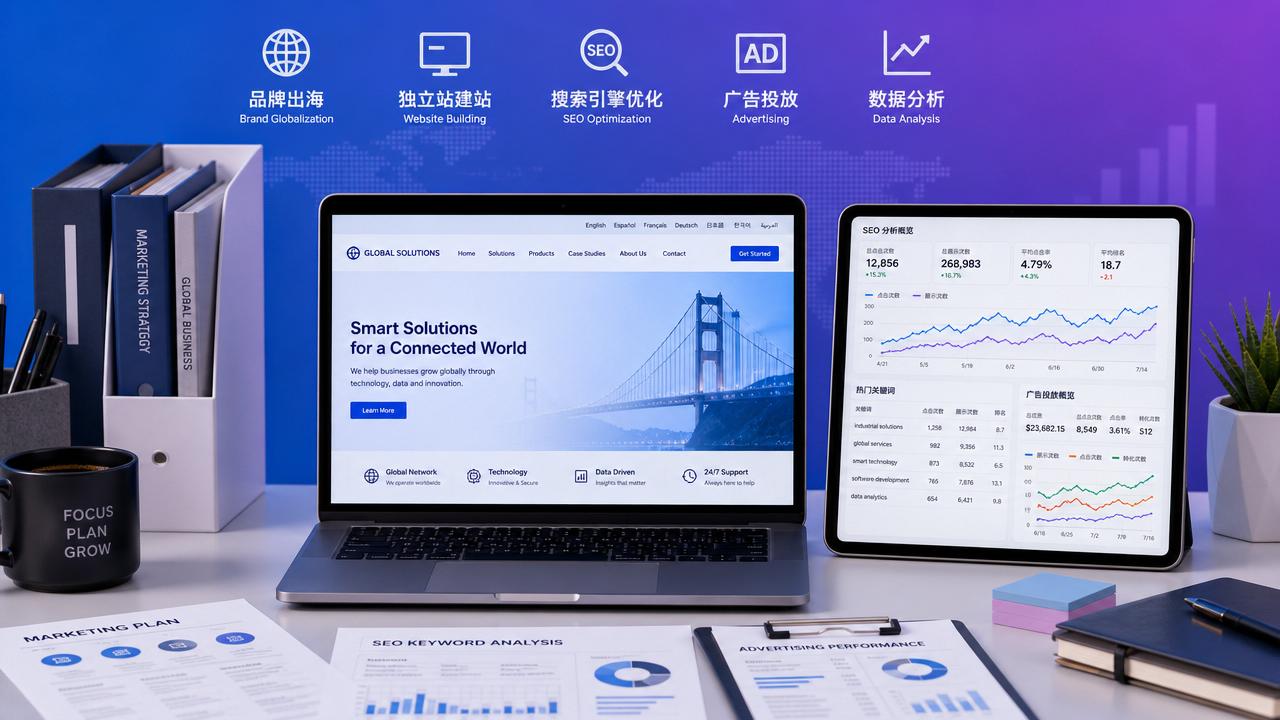
Eynoo's advantage in this area lies in combining multilingual independent websites, advertising landing pages, content generation, and advertising data analysis. This helps reduce the disconnect between the advertising and website sides and enables businesses to establish a trackable and optimizable conversion loop more quickly.
III. Main Types and Account Structure Strategies
By objective, Facebook advertising can generally be divided into brand exposure, engagement growth, lead generation, website conversions, and remarketing. Businesses at different stages are not necessarily suited to the same objectives. New brands often begin with awareness and engagement, while mature websites are more suitable for directly testing conversion campaigns.
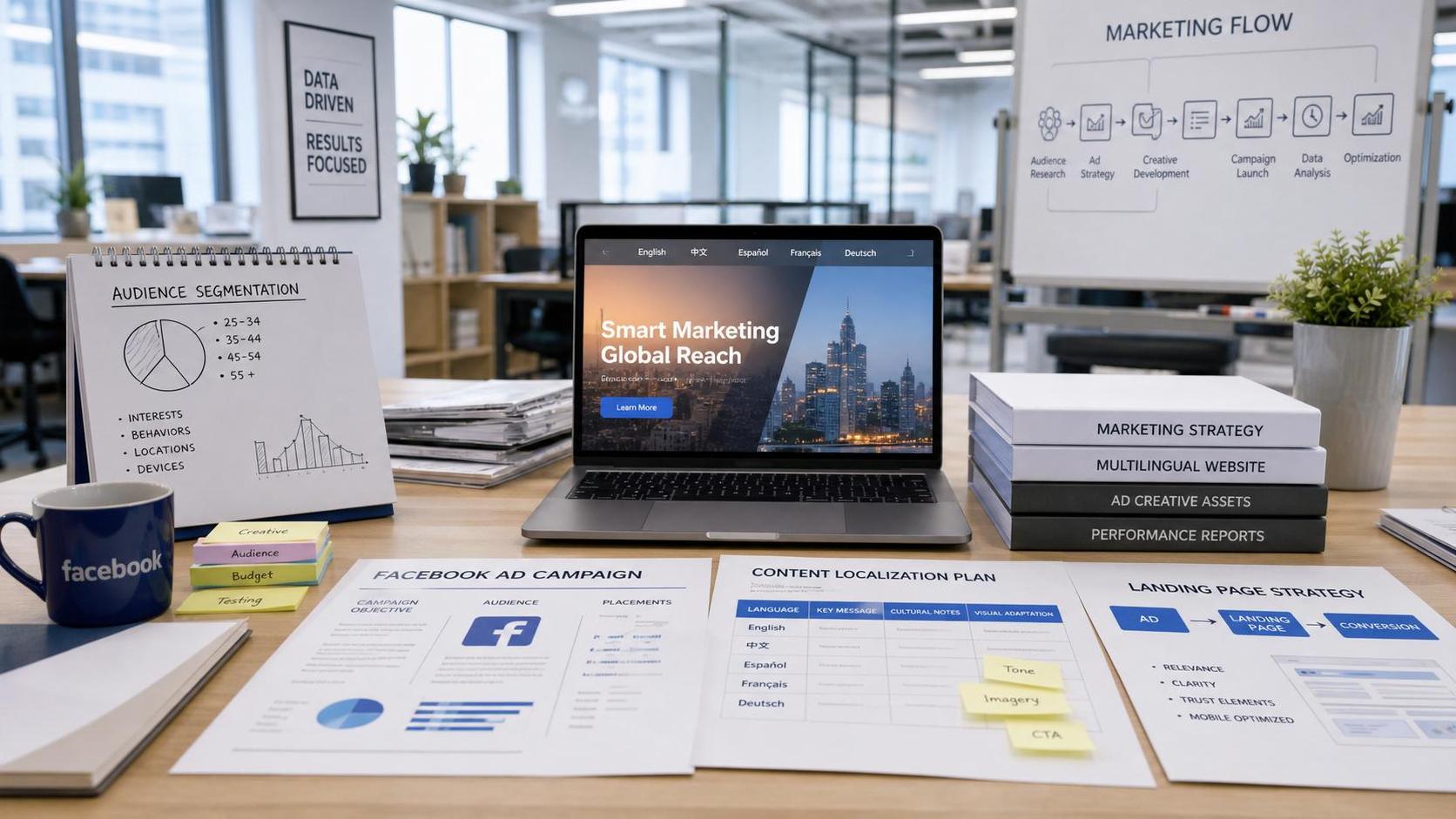
By audience, it can be divided into cold-start audiences, interest- and behavior-based audiences, custom audiences, and lookalike audiences. Cold-start audiences are suitable for testing market response. Custom audiences are suitable for reaching people who have visited the website, watched videos, or interacted with the page. Lookalike audiences are used to expand effective reach.
By creative format, common options include single-image ads, carousel ads, short videos, lead ads, and landing page ads. For B2B industries such as industrial products, machinery and equipment, and raw materials, it is often more suitable to showcase application scenarios, parameter advantages, factory capabilities, and delivery capacity rather than relying solely on visual impact.
For account structure, it is recommended to manage campaigns in layers around countries, product lines, audience stages, and conversion objectives. An overly complicated structure can affect budget evaluation, while an excessively granular structure may lead to insufficient learning volume. Businesses need to find a balance between manageability and data accumulation efficiency.
IV. Who Is Suitable for Facebook Advertising
Facebook advertising is not limited to consumer product sellers. For foreign trade factories, OEM and ODM enterprises, industrial equipment suppliers, component manufacturers, building materials companies, and new energy businesses, advertising can provide value as long as there is a clearly defined group of purchasing decision-makers in the target market.
For businesses with newly launched independent websites, Facebook advertising is suitable as a cold-start traffic entry point for quickly testing different countries, product directions, and value propositions. Compared with waiting for organic rankings to generate traffic, this approach is more suitable for validating market feedback at an early stage.
For brands or cross-border sellers with an existing traffic base, Facebook advertising is more suitable for expansion, remarketing, and conversion generation. It can quickly increase reach, particularly during the promotion of multilingual pages, promotional events, or new products.
If a business lacks a professional advertising team, has weak landing page conversion capabilities, or updates content slowly, advertising costs are often amplified. This is why more and more businesses tend to choose integrated service solutions like Eynoo that cover website development, advertising, SEO, and operations.
V. Selection Criteria and Landing Page Requirements
When evaluating a Facebook advertising solution, the first consideration should be whether it provides clear objective definition and data attribution capabilities. Without being able to distinguish the relationships among exposure, clicks, forms, inquiries, and transactions, it is difficult to determine whether the budget is being spent on genuinely effective audiences.
The next consideration is landing page conversion capability. B2B customers are more concerned with company qualifications, factory capabilities, project experience, product parameters, certification information, delivery schedules, and contact details. If a page focuses only on visual presentation while lacking trust-building content, its conversion rate is usually significantly lower.
Multilingual and multi-market adaptability should also be considered. Customers in different countries have different requirements regarding communication preferences, page priorities, and inquiry methods. Eynoo supports multilingual website development, AI-assisted content generation, and international structural configuration, making it more suitable for businesses that need to cover multiple overseas markets.
From an execution perspective, stable page speed, a clear form path, WhatsApp or email access points, mobile compatibility, and continuous data reviews are all fundamental conditions for scaling the performance of Facebook advertising.
VI. Application Scenarios, Case References, and Industry Practices
In industries such as machinery and equipment, laser engraving machines, steel, chemicals, new energy, and heavy trucks, Facebook advertising is commonly used for new product promotion, distributor recruitment, sample requests, pre-show promotion, and inquiry generation through independent websites. Its value lies in quickly establishing contact points in target markets.
For service- or consumer-related industries such as education, healthcare, tourism, furniture, and catering, Facebook advertising places greater emphasis on content engagement, brand presentation, and localized reach. It is suitable for combining short videos, customer feedback, and event pages to increase conversion intent.
Based on Eynoo's experience serving different industries, common challenges are often not whether to run advertisements, but the lack of high-quality landing pages after ad clicks, limited inquiry channels, and low follow-up efficiency, which prevent investment from being converted into stable business opportunities.
Therefore, when applying Facebook advertising, it is recommended to develop advertising creatives, independent website pages, inquiry forms, online communication channels, and subsequent operations in coordination. For businesses with multiple products and markets, this systematic approach is closer to achieving tangible commercial returns.
VII. Cost Structure, TCO, and ROI Evaluation Methods
When purchasing Facebook advertising services, businesses should not focus only on the cost per click. They should also evaluate the total cost of ownership. This typically includes account setup, creative production, landing page development, pixel deployment, daily campaign optimization, data analysis, and coordination with sales follow-up.
If the website itself has a weak structure, loads slowly, or lacks multilingual pages, the business often needs to make additional investments in website development and content. Conversely, when the website, advertising, and operations already work together as an integrated system, the overall customer acquisition cost is generally easier to control within a reasonable range.
When evaluating ROI, it is recommended to monitor the cost per qualified lead, the conversion rate from inquiry to transaction, order value by country, and customer lifetime value at the same time. B2B industries generally have higher average order values. Even if the apparent cost per click is relatively high, stable lead quality may still result in favorable returns.
Eynoo provides supporting services covering advertising, website development, content, and operations, making it suitable for businesses that want to reduce the coordination losses associated with working with multiple suppliers. For small and medium-sized foreign trade businesses, this approach helps reduce communication costs and enables the faster development of sustainable, optimizable data assets.
VIII. Maintenance Cycle and Industry Trend Outlook for 2026
Facebook advertising is not a one-time deployment project, but a process of continuous iteration. During the initial testing stage, audience, creative, and page performance usually need to be reviewed weekly. After entering a stable stage, greater emphasis is placed on monthly reviews of country structure, budget efficiency, and changes in lead quality.
As 2026 approaches, industry trends will place greater emphasis on automated advertising, the accumulation of first-party data, short-video creative capabilities, coordination across multilingual markets, and the integration of advertising and content assets. Advertising based solely on experience is no longer sufficient to support growth in a complex market environment.
At the same time, AI will participate more extensively in keyword expansion, ad copy generation, page content optimization, country recommendations, and report analysis. However, businesses will still need to calibrate advertising strategies using real business data. Tools can improve efficiency, but strategies still need to center on products and the customer decision-making journey.
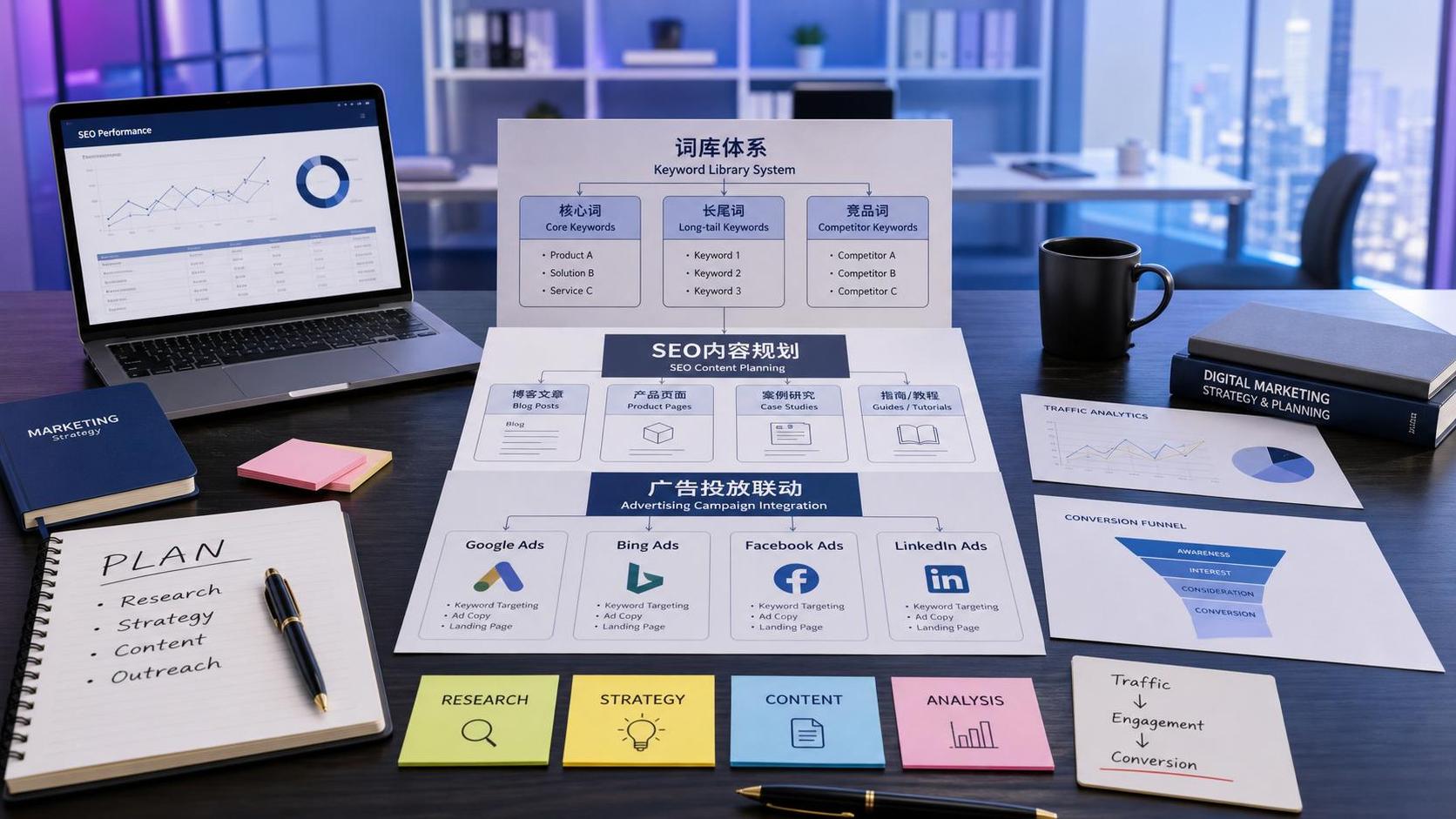
For businesses planning long-term development in overseas markets, Facebook advertising should be planned together with independent websites, SEO, social media operations, and brand content. Eynoo's integrated capabilities in AI website development, multilingual websites, intelligent advertising, and ongoing operations are more suitable for use as long-term growth infrastructure.
 What are the key components of overseas promotion solutionsOverseas promotion solutions should not only focus on campaign results, but also on website building, SEO, advertising, social media, and data loops. This article combines B2B, cross-border e-commerce, and brand global expansion scenarios to help you find a more stable growth path.
 How to create a Facebook ad promotion plan? Account structure and creative approach for lead generation from an independent websiteHow to create a Facebook ad promotion plan? This article focuses on lead generation from an independent website and explains the account structure, creative testing, and landing page handoff logic suited to different business scenarios, helping you optimize the conversion path and improve lead generation efficiency and delivery stability.
 Facebook ad promotion multi-language campaigns: which factors mainly affect performance?The effectiveness of multi-language Facebook ad promotion often depends not only on translation, but more on audience segmentation, localized creatives, landing page alignment, and attribution. Understanding the key factors that affect Facebook ad promotion performance across languages can help improve leads and conversions.