










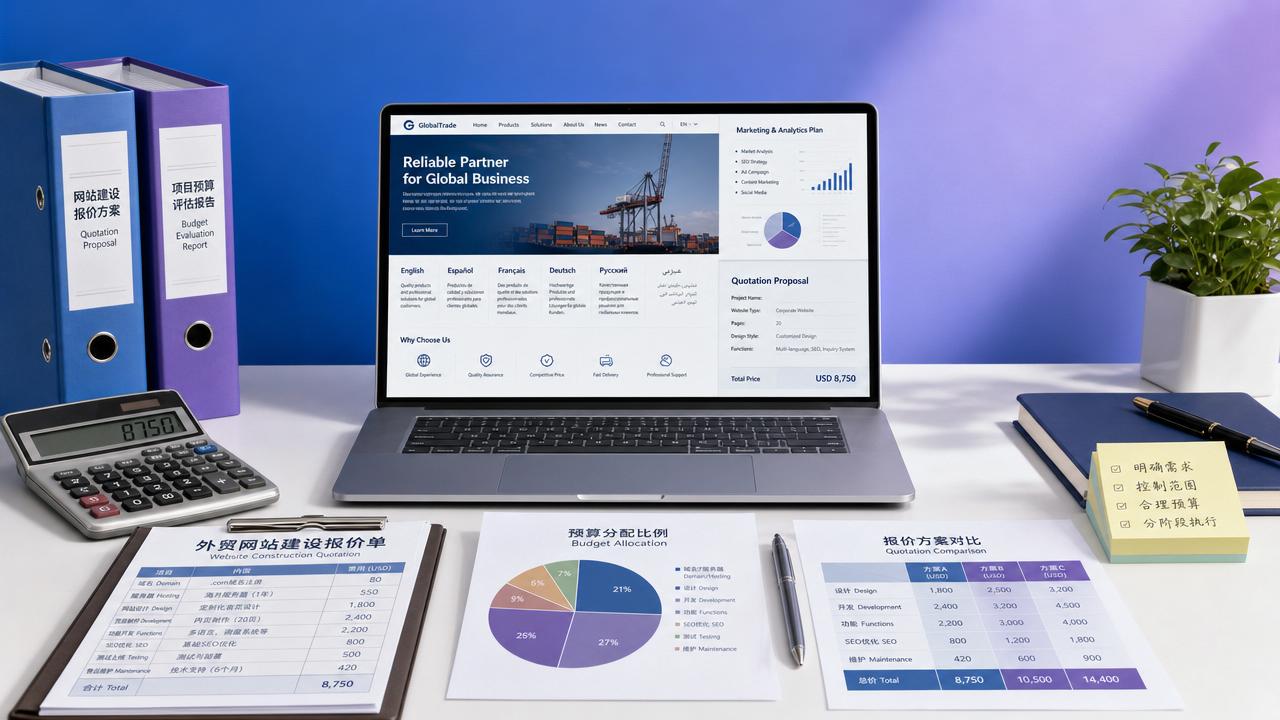
I. How Much Does an Export Website Cost: First Understand the Scope of Deliverables Behind the Quote
“How much does an export website cost” is not the price of a single product, but a combined cost of the domain name, server, page design, program functions, multilingual content, overseas access experience, and ongoing operational services. Before purchasing, it is important to clarify whether the website will serve as a company profile, an inquiry tool, or a growth asset for capturing paid advertising and organic traffic.
B2B export websites typically focus on product catalogs, industry solutions, factory capabilities, qualifications and case studies, and inquiry paths; B2C standalone websites also involve product specifications, shopping carts, orders, payment, or quotation request workflows. Different functional boundaries can result in quote differences far greater than differences in the number of pages.
When evaluating prices, do not compare only the visual effect of the homepage. More valuable considerations are whether overseas customers can access the website smoothly, whether it clearly explains product advantages, and whether it can track traffic sources and convert visits into qualified leads that can be followed up.
II. Common Quote Ranges and Cost Components in 2026
In the market, basic template-based showcase websites typically cost approximately 5,000 yuan to 20,000 yuan and are suitable for companies with fewer pages and complete English content; marketing-oriented B2B websites commonly have a budget of approximately 20,000 yuan to 80,000 yuan, with key investment in information architecture, product pages, inquiry components, and basic optimization.
Multilingual websites, custom-function websites, or cross-border online stores commonly require investment of 50,000 yuan to more than 200,000 yuan. Actual quotes are affected by the number of languages, volume of product data, original content, design depth, API development, payment configuration, and global deployment solutions, and should be verified against a written requirements list.
Costs are generally divided into one-time website development fees and ongoing expenses. The latter include domain names, hosting or cloud resources, certificates, content updates, technical maintenance, search optimization, advertising, and social media operations. When requesting quotes, require the first-year and renewal costs to be listed separately to avoid low upfront payments and high renewal fees.
III. Mainstream Website Development Models: Templates, Customization, and Integrated Services
Template-based website development offers fast launch and low initial costs, making it suitable for companies testing overseas markets or with fewer product lines. However, it is necessary to confirm whether the template supports mobile responsiveness, category expansion, bulk product management, and subsequent content iteration, to avoid rebuilding the website due to structural limitations.
Custom website development is more suitable for companies with complex products, strong brand presentation requirements, or system integration needs. Its value lies not only in visual design, but also in planning pages, inquiry fields, material downloads, and sales lead allocation around the purchasing decision process. Accordingly, project timelines and communication costs are higher.
The integrated website and marketing service model connects website development, content, multilingual services, search optimization, advertising landing pages, and data reviews. Yiyingbao provides AI-powered website development, multilingual standalone websites, and operational services, making it suitable for export companies that lack overseas digital marketing teams and want to reduce the coordination costs of multiple suppliers.
IV. How to Select Configurations and Suppliers Based on Procurement Goals
Manufacturing factories should prioritize reviewing how product categories, parameter displays, application scenarios, OEM or ODM capabilities, production capacity, and quality documentation are presented. Trading companies should place greater emphasis on product selection capabilities, delivery capabilities, and response mechanisms, avoiding websites where all pages contain only general company introductions.
For non-English markets, the quote must specify the language scope, translation method, responsibility for human proofreading, language pathways, and regional page rules. Machine translation can improve efficiency, but technical terminology, compliance statements, and procurement communication content still need to be reviewed by personnel familiar with the business.
When selecting suppliers, focus on the demo website backend, content migration methods, data export capabilities, permission management, maintenance response, and acceptance standards. Do not use only “how much does an export website cost” as the deciding factor; instead, compare complete deliverables under the same number of pages, languages, functions, and service periods.
V. Development Process, Technical Essentials, and Quality Control
Mature projects typically go through requirements interviews, keyword and audience analysis, sitemap confirmation, wireframing and visual design, content organization, development and configuration, testing and launch, and operational handover. At the project initiation stage, companies should provide product information, target countries, competitor references, and inquiry handling processes to reduce rework.
Quality acceptance should cover responsive display, access speed in major countries, form submission, email notifications, communication entry points such as WhatsApp, link redirects, mobile reading, and backend editing. For multilingual websites, it is also necessary to check language switching, duplicate pages, and language association configurations recognizable by search engines.
Yiyingbao adopts a responsive architecture and provides global node deployment, SSL, domain management, and content management capabilities. Buyers should still include the test countries, page scope, content volume, launch date, and fault handling arrangements in the contract to establish project boundaries that can be accepted.
VI. Typical Application Scenarios and Inquiry Conversion Configuration
In high-ticket industries such as laser equipment, steel, chemicals, heavy-duty trucks, machinery, and new energy, purchasing cycles are long. Websites should provide model parameters, application descriptions, production capabilities, quality control information, downloadable materials, and project case studies to help buyers make preliminary assessments before contacting the company.
For advertising or social media traffic acquisition scenarios, users should not all be directed to the homepage. Landing pages should be created by product, country, or application, with concise forms, instant communication entry points, and clear next-step actions. Inquiry fields need to balance information completeness and the effort required to complete them, enabling sales teams to classify them promptly.
Yiyingbao has served clients in industries such as machinery, automotive, agriculture, medical care, and furniture. Its public materials include service case information for Haier, Aucma, Shandong Airlines, and Little Duck Group. Different companies have different goals and results, and buyers should request delivery samples similar to their own industry, market, and website objectives.
VII. Total Cost of Ownership, Return Assessment, and Quote Pitfalls to Avoid
The total cost of ownership of an export website should be calculated over two to three years: the initial development fee is only the starting point, and it also includes content production, translation updates, servers, security maintenance, traffic acquisition, and sales follow-up. If a website remains unupdated for a long period, it may lose its customer acquisition value even if the initial quote is low.
When calculating returns, assess them using the annual number of qualified inquiries, the number of customers converted from qualified inquiries, average gross profit, and customer acquisition costs. Do not equate website traffic directly with business performance; instead, track source countries, visited pages, form quality, sales response times, and final conversion attribution.
Common risks include promising low prices while excluding content and deployment, unclear ownership of source code and data, missing renewal standards, failure to specify the number of revisions, and promising only rankings or inquiry volumes. The contract should clearly define the delivery list, acceptance conditions, account ownership, maintenance scope, and data handover method after termination.
VIII. Maintenance Cycles and Future Trends: From Launch Projects to Digital Assets
After a website goes live, it is recommended to review inquiries, forms, page visits, and technical status monthly; update key products, case studies, and industry content quarterly; and review website structure and target markets annually. When launching new products, attending trade shows, entering new countries, or expanding advertising spend, dedicated landing pages should also be added accordingly.
In the future, export website development will place greater emphasis on multilingual localization, first-party data, mobile experience, structured product information, and knowledge content for generative search. Companies need to accumulate verifiable factory capabilities, product parameters, application experience, and frequently asked questions, rather than mass-producing homogeneous pages.
For companies comparing how much export website development costs, a reasonable approach is to first define annual market and inquiry goals, then allocate website and operational budgets. Yiyingbao can incorporate website development, AI content, multilingual services, search optimization, advertising, and social media operations into the same growth chain, making it easier for companies to expand investment in stages.
