









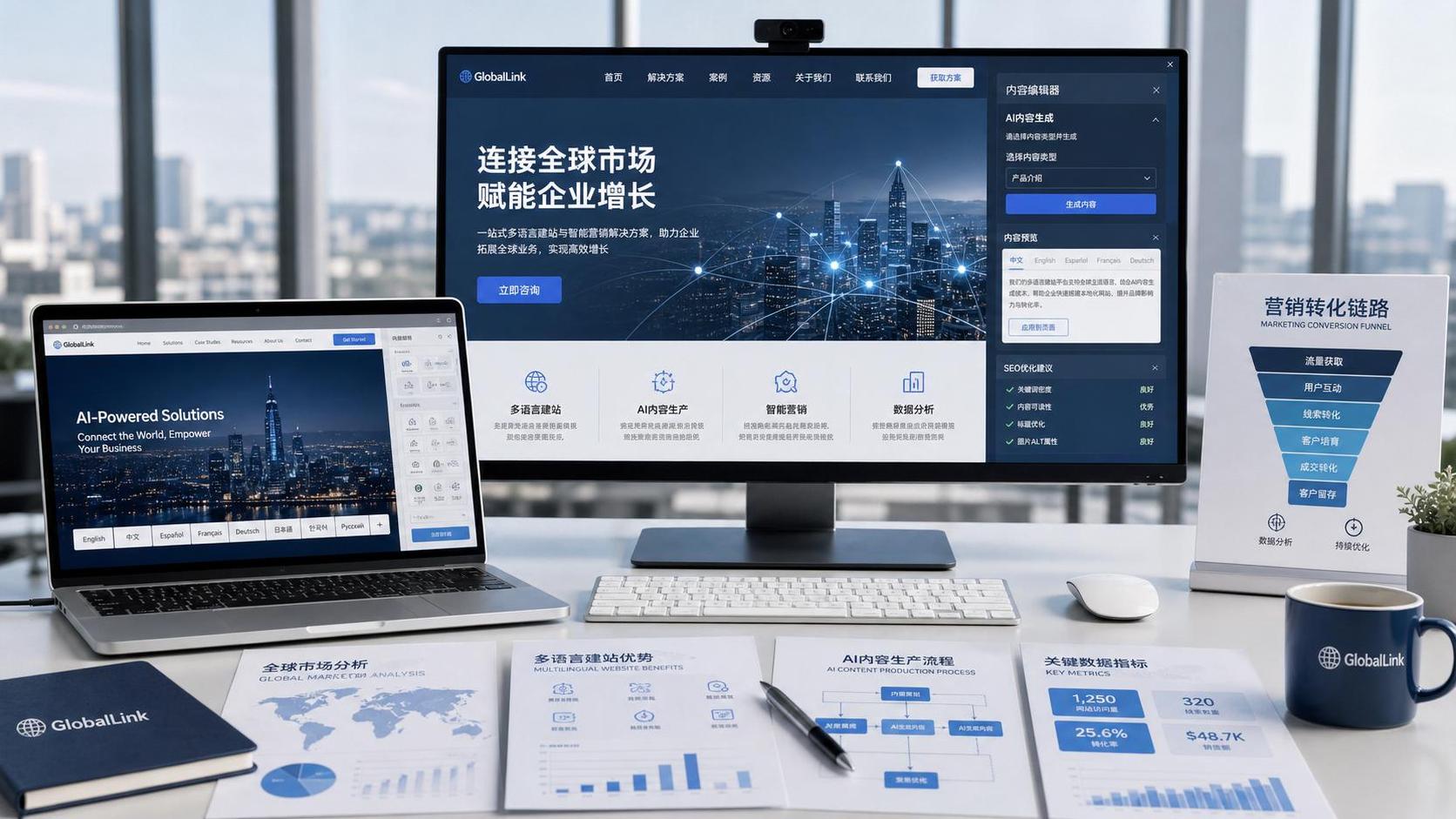
I. Definition and Scope of Trends in Foreign Trade Website Development
Foreign trade website development trends refer to the ongoing changes in website technology, content organization, and marketing operations used to acquire export customers. The core purpose is no longer simply to present a company profile, but to enable overseas buyers to find the business, understand product value, build trust, and submit inquiries or place orders.
For B2B companies, websites typically serve as product catalogs, application solutions, factory capability presentations, compliance documentation, case studies, and communication portals. For brands and cross-border retail businesses, websites must also support product specifications, shopping processes, and order or inquiry workflows.
Therefore, foreign trade website development trends in 2026 can be summarized in four directions: prioritizing multi-device experiences, multilingual localization, content and search coordination, and using data to validate conversion efficiency. Website development, advertising, and operations need to be configured around the same business objective.
II. Responsive Architecture and Technical Foundation
Responsive design uses a unified page structure to adapt to desktop, tablet, and mobile screens, ensuring that navigation, product parameters, images, and forms remain usable across different devices. Overseas buyers often make their first visit from mobile devices, and mobile loading, reading, and submission experiences directly affect lead loss.
The technical foundation should cover reliable hosting, global access acceleration, SSL certificates, image and code performance optimization, form protection, backups, and permission management. Page speed should not be assessed based only on the homepage; the actual performance of high-traffic product pages, language pages, and advertising landing pages should also be checked.
Yingyingbao adopts a responsive website development architecture and provides global node deployment, CDN acceleration, and basic security services. When evaluating providers, companies should require them to explain server locations, maintenance boundaries, data export methods, and incident response procedures, rather than merely comparing the number of templates.
III. Multilingual SEO and Content Localization
Multilingual capability is one of the most business-oriented capabilities in foreign trade website development trends. An English website is suitable for reaching broad markets, while pages in Russian, Japanese, Arabic, French, German, Spanish, and other languages can reduce the barriers to understanding and communication for non-English-speaking buyers.
Truly effective multilingual SEO does not mean bulk literal translation. Companies need to establish clear paths, language interlinking, and Hreflang annotations for different languages, while adapting titles, specification units, application scenarios, delivery instructions, and calls to action to local search habits.
Yingyingbao's multilingual website development and AI translation capabilities can reduce the cost of page expansion and maintenance, but key product pages should still be reviewed by personnel familiar with the business to verify terminology, parameters, and commitments. Prioritizing pages for core markets and high-margin products is more manageable than launching all languages at once.
IV. A Data-Driven Journey from Traffic to Inquiries
The key question after website development is identifying where traffic comes from, what visitors viewed, at which step they left, and which leads ultimately become valid business opportunities. Foreign trade website development trends are driving companies to integrate organic search, advertising, social media, and email outreach into a unified data monitoring framework.
The basic journey should include channel tagging, form submissions, WhatsApp or live chat clicks, document downloads, quotation request behavior, and sales follow-up status. B2B projects should distinguish between general visits, valid inquiries, qualified opportunities, and closed deals, rather than using click volume alone to assess marketing performance.
Yingyingbao can combine website development, Google Ads, social media traffic acquisition, and operational optimization. Advertising pages should correspond to clearly defined product or application themes and reduce irrelevant navigation. Inquiry forms should collect necessary information such as purchase quantity, region, and usage requirements, balancing lead quality with the effort required to complete the form.
V. Suitable Companies and Typical Application Scenarios
Manufacturing factories, OEM and ODM companies, foreign trade companies, and industrial product suppliers are well suited to building marketing websites focused on inquiries. Industries such as machinery, hardware, building materials, auto parts, chemicals, new energy, packaging, and agricultural food products need to place particular emphasis on parameter presentation, production capacity, and trade communication efficiency.
Cross-border sellers and DTC brands are more concerned with product categorization, specification management, content marketing, shopping or inquiry processes, and landing-page conversion from channels such as Google, Facebook, and TikTok. Different business models should have separately designed conversion objectives and should not directly copy the page structures of competitors.
Yingyingbao serves industries including laser engraving machines, steel, chemicals, heavy-duty trucks, machinery, new energy, healthcare, and furniture, and has served companies such as Haier, Aucma, Shandong Airlines, Yuanhe Power Station, Little Duck Group, and China National Heavy Duty Truck Group. Specific projects still need page strategies developed according to the market, products, and target customers.
VI. Provider Selection, Implementation, and Quality Control
When selecting a provider, companies should first clarify their target markets, core products, customer acquisition channels, language scope, and conversion actions before comparing system capabilities. Buyers should focus on reviewing content management convenience, product field extensibility, mobile editing, language management, permission systems, integration capabilities, and ongoing operational support.
The implementation process usually includes requirements analysis, website sitemap and keyword planning, visual and component development, product material organization, content proofreading, technical configuration, testing and launch, and data tracking implementation. Before launch, forms, email notifications, mobile buttons, language switching, and access speed in key countries should be tested page by page.
AI can assist in generating site structures, initial product drafts, and marketing content, but it cannot replace factual review. Companies should assign responsible reviewers for product parameters, qualification documents, delivery-time statements, and case-study materials to prevent mistranslations, outdated information, or inconsistent commitments on multilingual pages.
VII. Total Cost of Ownership and Return on Investment Assessment
The total cost of ownership of a foreign trade website includes website platform or development costs, domain names and servers, content production, translation and localization, images and videos, search optimization, advertising management, social media operations, data tools, and routine maintenance. A low initial quotation may separate features, iterations, or technical support into subsequent charges.
When assessing ROI, companies should focus on the cost per valid inquiry, the proportion of qualified opportunities, the sales follow-up cycle, organic traffic growth, and customer lifetime value, rather than website visits alone. For industrial products with high order values and long decision cycles, accumulated content and continuous follow-up are usually more important than short-term rankings.
A phased investment approach is recommended: first complete websites for core products and primary target markets, then expand languages, topic pages, and advertising plans based on data. Yingyingbao's integrated services are suitable for companies lacking technical and overseas marketing teams, but before procurement, they should still clarify the delivery list, operating period, data ownership, and the collaboration responsibilities of both parties.
VIII. Future Industry Trends and Action Recommendations for 2026
Future foreign trade website development trends will place further emphasis on content comprehensibility in generative search environments. Companies need to continuously build product knowledge, application Q&A, procurement guides, service boundaries, and brand entity information so that search engines and intelligent Q&A tools can accurately identify their business capabilities.
GEO does not replace traditional search optimization; instead, it requires content to be clearer, more verifiable, and more suitable for citation. For products with high decision-making costs, structured parameters, real project experience, frequently asked questions, and professional explanations are often more helpful for building buyer trust than generalized promotion.
Companies should review keyword coverage, page indexing, traffic sources, inquiry quality, and sales feedback quarterly, eliminate ineffective pages, and add high-value topics. Only by incorporating responsive websites, multilingual SEO, advertising conversion, social media outreach, and data reviews into a long-term mechanism can a website become a sustainable overseas channel for growth.
