









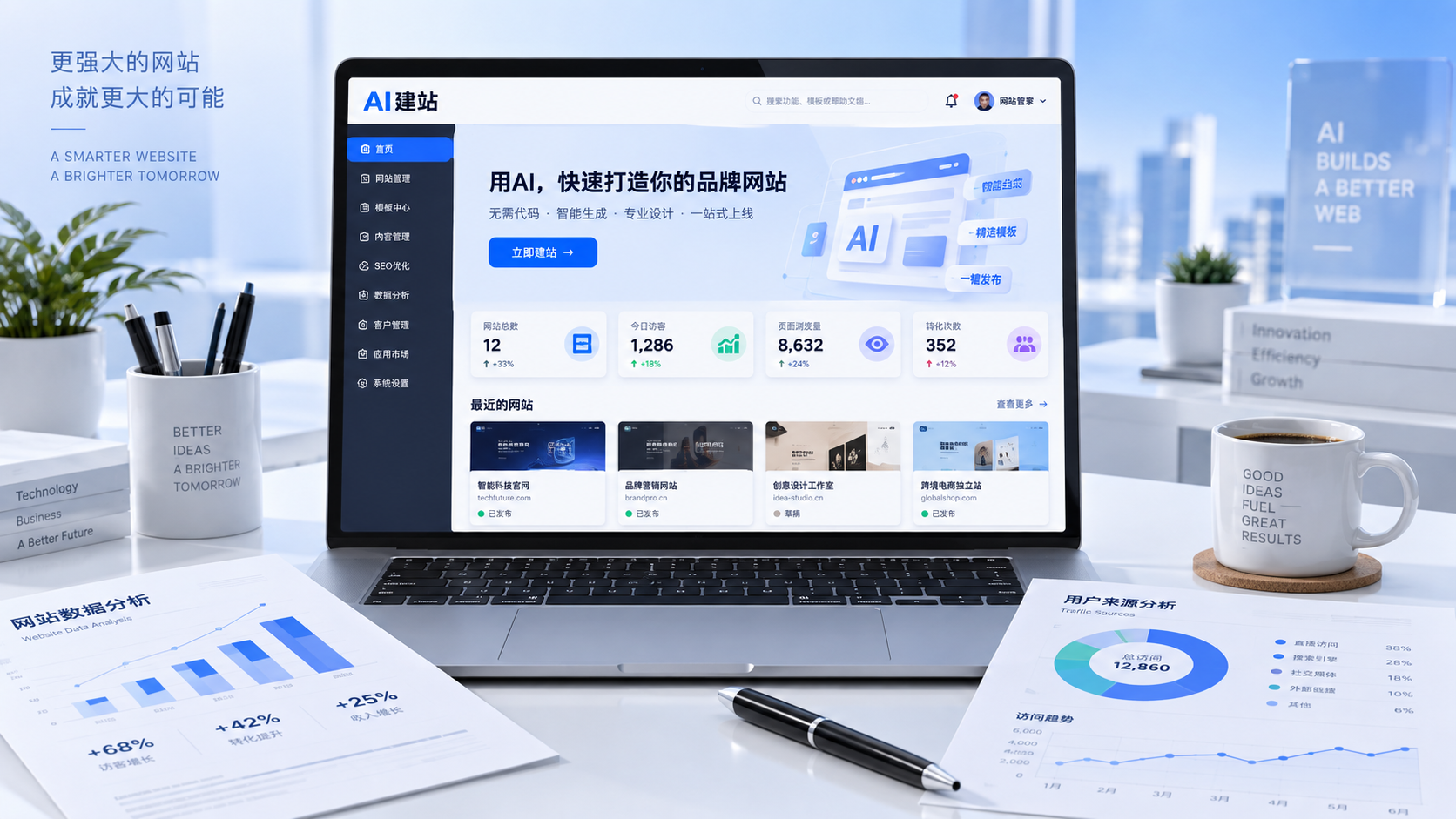
I. Definition and Scope of Enterprise AI Website Building
Enterprise AI website building is a website development approach based on a cloud-based website-building platform that incorporates AI-assisted content creation, page configuration, data management, and marketing optimization into a single workflow. Its delivery focus is not limited to visual pages, but also includes digital assets that enterprises can manage over the long term, continuously publish, and use to capture business leads.
Compared with one-off custom development, enterprise AI website building typically includes a template and component system, permission management, content management, multi-device compatibility, basic security configurations, and expandable interfaces. For foreign trade enterprises, it should also cover product catalogs, inquiry forms, instant communication entry points, proof of company capabilities, and an overseas user access experience.
It should be noted that AI cannot replace the verification of product parameters, trade compliance reviews, or judgment regarding brand expression. A qualified enterprise AI website-building solution should position AI as an efficiency-enhancing tool while retaining mechanisms for manual review, version management, and traceable content maintenance.
II. Technical Principles and Key Architecture
The technical architecture typically consists of a front-end presentation layer, a content and product data layer, an AI generation and editing layer, a marketing tools layer, and an analytics layer. Responsive design enables one set of pages to adapt to both desktop and mobile devices, reducing content inconsistencies and landing page failures caused by multi-platform maintenance.
AI modules can assist in generating page frameworks, titles and descriptions, product introductions, article drafts, and advertising copy based on the industry, product selling points, and target market. However, output quality depends on the completeness of the input materials, so enterprises should first organize verifiable information such as models, specifications, applications, certificates, delivery times, and service boundaries.
The internationalization architecture should include clear language paths, separate language pages, localized content, and correct language association tags. Server deployment, CDN, image compression, caching strategies, and SSL configuration collectively affect the stability of overseas access, as well as visitor retention and willingness to submit inquiries from advertisements.
III. Main Types and Suitable Users
By business objective, enterprise AI websites can be categorized into foreign trade B2B inquiry sites, brand showcase sites, product catalog sites, campaign landing pages, and B2C cross-border online stores. B2B sites emphasize buyer trust, explanations of complex products, and lead qualification, while online stores focus more on product attributes, pricing, the shopping process, and order conversion.
Manufacturing factories, OEM or ODM enterprises, and industrial product suppliers are well suited to inquiry sites structured around product categories, solutions, factory capabilities, and case studies. Cross-border sellers and DTC brands can add product detail pages, review content, brand stories, and dedicated landing pages for advertising channels.
Yiyingbao provides AI-powered website building, multilingual independent websites, and website operation services, which can be used for foreign trade corporate websites, B2B marketing sites, cross-border online stores, and other scenarios. Its responsive architecture, AI content assistance, and global node resources are better suited to enterprises seeking unified management of website building, promotion, and subsequent operations.
IV. Procurement Selection Criteria and Implementation Process
When making a purchase, enterprises should first clarify their growth objectives: whether to acquire overseas inquiries, establish a brand presence, cover multilingual markets, or improve advertising conversion. These objectives determine the section structure, content priorities, and data metrics, preventing the website from becoming a collection of materials that cannot answer buyers' key decision-making questions.
Platform evaluation should focus on data ownership, content export capabilities, permission settings, backup and recovery, page loading performance, mobile editing, multilingual maintenance, form lead routing, and third-party tool integration. For long-term operational projects, the service scope, response time, and collaboration methods for subsequent optimization should also be confirmed.
Implementation can proceed through material inventory, keyword and market research, information architecture, visual and page development, content review, technical inspection, launch monitoring, and continuous iteration. The more complete the original materials, such as product images, test reports, application videos, and customer FAQs, the more accurate the content output of enterprise AI website building will be.
V. Content, Search, and Marketing Conversion
High-quality website content should be organized around the purchasing decision journey. The homepage explains the company's positioning and core value; category pages help visitors understand the product range; detail pages present specifications, materials, uses, customization capabilities, and inquiry methods; while solution and knowledge pages answer application and product selection questions.
Search visibility relies on a clear page hierarchy, unique and accurate titles and descriptions, crawlable body content, internal links, and a stable technical foundation. AI can expand long-tail topics and multilingual first drafts, but duplicate pages, unverified parameters, and mechanical translation can weaken page value and require review by business personnel.
Enterprise AI websites should also undertake the conversion of advertising and social media traffic. Corresponding landing pages should be used for different countries, product lines, and purchasing stages, with leads captured through forms, WhatsApp, email, or online customer service. Only by reviewing traffic sources, page behavior, and inquiry quality can enterprises determine whether channel investment is effective.
VI. Operating Cycles, Case Experience, and Risk Control
After a website goes live, it is recommended to check indexing, traffic sources, key pages, form availability, and loading performance monthly, and update product information, industry articles, and market pages quarterly. New product launches, trade shows, entry into new national markets, or the start of advertising campaigns are all suitable points for expanding pages and adjusting the content structure.
Yiyingbao's services cover industries such as laser engraving machines, steel, chemicals, heavy trucks, machinery, new energy, medical care, and furniture, and list service cases including Haier, Aokema, Shandong Airlines, Yuanhe Power Station, Little Duck Group, and China National Heavy Duty Truck Group. The objectives and results of different projects should be subject to the actual contract scope, business materials, and operational data.
Risk control priorities include ownership of domain names and backend accounts, regular backups, tiered permissions, privacy policies, form anti-spam measures, prevention of sensitive data leakage, and fact-checking of AI-generated content. Yiyingbao has released multiple versions of website-building and foreign trade marketing systems; purchasers should still confirm data security responsibilities and handover mechanisms before cooperation.
VII. Total Cost of Ownership and Trends for 2026
The total cost of ownership for enterprise AI website building should not be compared solely based on the initial production quotation. It also includes domain names, servers or traffic, SSL, plugins, language versions, content production, images and videos, advertising landing pages, technical maintenance, and operating staff time. A low-cost launch that cannot be continuously updated often increases subsequent migration and rebuilding costs.
Return on investment can be evaluated through the number of qualified inquiries, inquiry qualification rate, share of organic traffic, advertising conversion cost, coverage of key markets, and sales follow-up efficiency. It is recommended to establish a pre-launch baseline and unify lead definitions across the website, advertising, social media, and CRM, rather than judging project value solely by traffic volume.
In 2026, generative search and question-and-answer entry points will drive enterprises to strengthen entity information, structured Q&A, professional knowledge bases, and trustworthy multilingual content. Enterprise AI website building will evolve from rapidly generating pages into a long-term operating system that combines content governance, GEO visibility, marketing automation, and data-driven iteration.
