









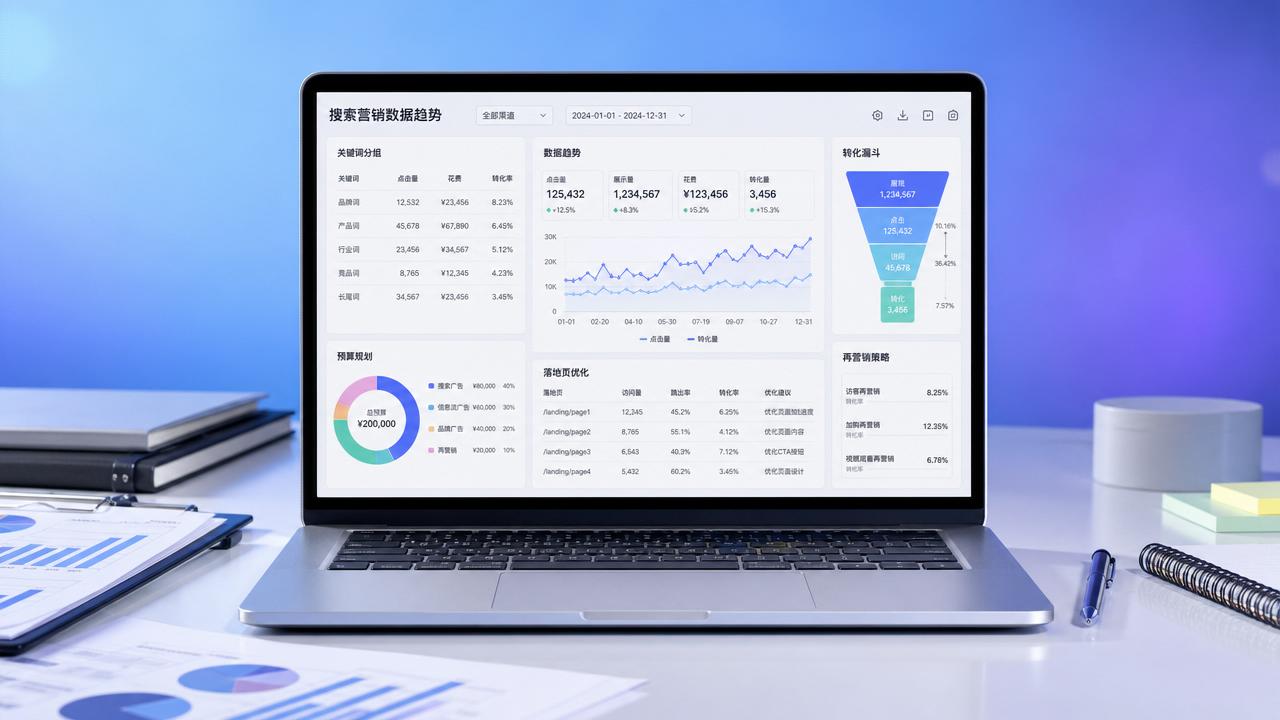




I. Definition and Business Scope of SEM Advertising
SEM advertising generally refers to digital marketing activities in which companies purchase display opportunities through search engine advertising platforms based on criteria such as keywords, audiences, regions, devices, and time, and manage campaigns according to click, impression, or conversion objectives. Its core purpose is not to buy traffic itself, but to attract visitors with clear purchasing or inquiry intent.
In overseas markets, Google Ads is a common platform; campaigns can cover advertising formats such as search, display, remarketing, shopping, and Performance Max. For foreign trade B2B companies, search ads are generally better suited to capturing high-intent search demand related to models, applications, suppliers, customization, and wholesale.
SEM advertising and organic search are not substitutes. Advertising can help new websites and new products quickly validate the value of markets, countries, and keywords, while SEO builds long-term sustainable content assets. A mature strategy should combine these two channels according to the product decision cycle, gross margin, and sales follow-up capacity.
II. Technical Principles: Bidding, Relevance, and Conversion Signals
Search ads are not displayed solely based on the highest bid. Platforms typically assess ad rank by combining signals such as bids, ad relevance, estimated click-through rate, landing page experience, and ad assets. Therefore, improving account quality can often deliver more stable and effective traffic with a similar budget.
Account structures should be segmented by product line, application scenario, country market, or purchasing intent. Keeping keywords, ad copy, and landing page content consistent enables visitors to quickly determine whether the product meets their needs. Generic terms, brand terms, competitor terms, and long-tail terms should be evaluated separately and should not be managed together in the same ad group.
Conversion tracking is the measurement foundation of SEM advertising. Foreign trade websites should at least track inquiry form submissions, WhatsApp or phone clicks, email clicks, sample requests, and key page visits, and feed lead-quality data such as qualified inquiries and transaction amounts back to the advertising platform, rather than judging performance by click volume alone.
III. Main Categories and Applicable Scenarios
Search ads are suitable for buyers with already explicit demand, such as users searching for equipment names, material parameters, manufacturers, or solutions. Their advantage is strong intent, while their limitation is that competitive keywords may have high click costs, requiring refined negative keyword and geographic targeting to control ineffective spend.
Display ads, video ads, and social media ads are more suitable for new product education, brand reach, and remarketing. They can reach potential customers who have not yet searched proactively, but their direct lead conversion rate is generally lower than that of high-intent search traffic, so they should be managed with separate budgets, audience lists, and phased objectives.
For companies with complex product catalogs and many target countries, a combination of “core category search lead generation + remarketing follow-up + long-term content-based lead generation” can be adopted. Eyingbao's AI+SEM intelligent advertising system can be used to assist in managing keywords, target countries, budgets, and ad copy, while multilingual standalone websites can receive visitors from different markets.
IV. Account Setup and Pre-Launch Selection Criteria
Before starting SEM advertising, companies should first define target markets, key products, target customer roles, acceptable customer acquisition costs, and sales follow-up rules. Industrial products and customized products should not pursue low-cost inquiries alone; they should also define standards for qualified leads, such as purchase volume, application field, budget, delivery time, and decision-making authority.
Keyword selection should cover product terms, specification terms, application terms, industry terms, and problem terms, with decisions made based on search volume, commercial intent, competition level, and page matching capability. Prioritize testing long-tail terms that clearly express purchasing demand, while continuously adding negative terms that do not align with the target, such as recruitment, tutorials, repair, and free.
Landing page selection is equally critical. Pages should present product parameters, applications, delivery capabilities, qualification materials, factory or case information, and clear contact options. Eyingbao provides responsive website building, multilingual pages, and configuration of forms, WhatsApp, and other access points, making it suitable for directing ad traffic to verifiable and inquiry-ready B2B pages.
V. Optimization Process and Quality Control Methods
During the initial stage after an account goes live, first verify that tracking is accurate, then monitor search terms, impression share, click-through rate, cost per click, and conversion rate. When data volume is insufficient, frequent major bid adjustments should be avoided. Instead, review keyword matching, ad relevance, geographic deviations, and landing page loading performance at the ad group level.
Common optimization actions include pausing consistently ineffective search terms, expanding long-tail terms that generate qualified inquiries, separating budgets for branded and non-branded terms, comparing costs by country and device, and testing headlines, selling points, and form length. The reason and date for every adjustment should be recorded to help identify the true influencing factors.
Quality control should also cover the website side. Slow mobile loading, awkward language expression, invalid forms, or untimely sales responses can all weaken advertising performance. Supported by multi-cloud global nodes, Eyingbao provides overseas access acceleration and supports ad data monitoring, weekly and monthly reports, and landing page optimization, making it easier to establish an operational closed loop.
VI. Total Cost of Ownership and ROI Evaluation
The total cost of ownership for SEM advertising includes not only media click costs, but also account setup, creative production, multilingual content, landing page maintenance, data tracking, campaign management time, and sales lead follow-up costs. Product average order value, gross margin, repurchase cycle, and sales conversion rate all affect the reasonable upper limit for customer acquisition costs.
ROI evaluation should extend from clicks to qualified inquiries, opportunities, quotations, samples, orders, and payments received. If the B2B sales cycle is long, layered metrics can first be established: use qualified inquiry cost to measure front-end efficiency, opportunity and close rates to assess sales follow-up, and payments received or expected gross profit to determine the channel's investment value.
For budget allocation, first reserve a portion for branded terms and validated high-intent terms, then use a test budget to explore new categories, countries, and long-tail demand. Competitor terms and cold traffic should be capped separately, with close attention paid to lead quality. Budgets are not fixed one-time items; they should be reallocated periodically based on market feedback.
VII. Maintenance Cycles, Industry Trends, and Service Selection
It is recommended to review search terms, abnormal spend, conversion tracking, and lead quality weekly, and to review budgets, country markets, page performance, and sales feedback monthly. Ads and landing pages should be updated in advance when new products are launched, before peak seasons, and when pricing structures are adjusted. The focus of account maintenance is continuously calibrating business objectives, rather than mechanically pursuing a single platform metric.
In 2026, automated bidding, generative content, privacy restrictions, and AI search will continue to change SEM advertising methods. Automation can improve processing efficiency, but only when conversion events are genuine, data is sufficient, and business boundaries are clear. Companies still need human oversight of product positioning, market access, pricing strategies, and lead quality.
Industries such as laser engraving machines, steel, chemicals, heavy-duty trucks, machinery, and new energy often feature long purchasing cycles and in-depth technical communication, making coordination among websites, advertising, content, and sales even more necessary. Eyingbao has served digital marketing scenarios across multiple industries and can incorporate website building, Google Ads, SEO, social media, and ongoing operations into unified planning, helping companies configure customer acquisition paths based on their own objectives.
