













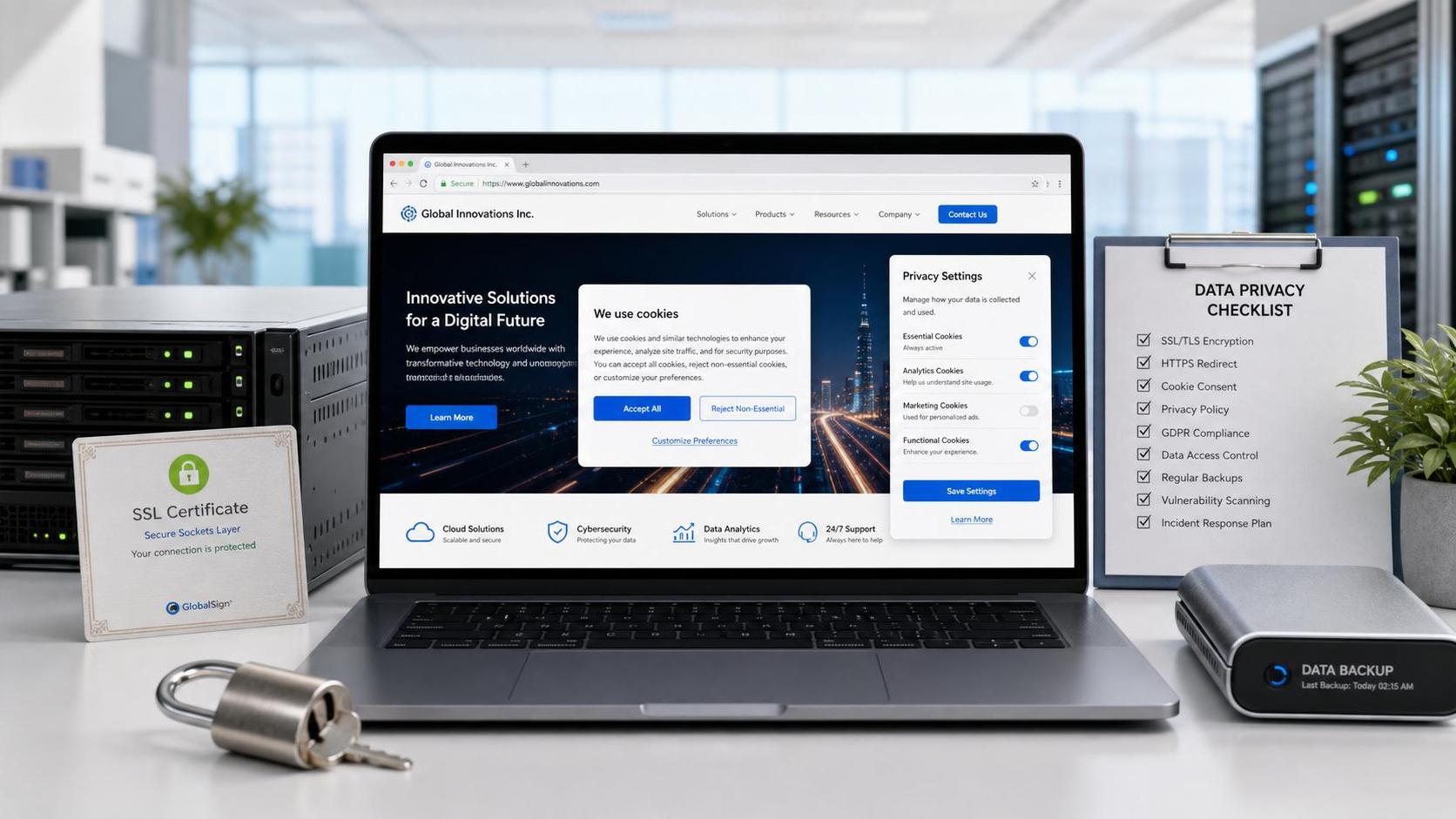
I. Definition and Risk Boundaries of SaaS Website-Building Security
SaaS website-building security refers to the comprehensive protection of accounts, data, applications, networks, and business continuity when enterprises create, publish, and operate official websites through cloud-based website-building platforms. It is not only about whether a website can be accessed, but also whether inquiry information, product materials, visitor privacy, and brand reputation can be controlled.
Common risks for foreign trade websites include weak passwords leading to backend takeover, forms being abused by spam, vulnerabilities in third-party plugins, accidental deletion of pages or product data, tampering with domain name resolution, and access disruptions caused by traffic surges or malicious requests. Multilingual websites also need to address the synchronized management of content and permissions in different languages.
Assessing SaaS website-building security should not be limited to whether an SSL certificate is configured. Buyers should also confirm data ownership, tenant isolation, login verification, operation logging, backup and recovery, vulnerability remediation responsibilities, and incident response mechanisms, rather than leaving all security responsibilities to internal non-technical personnel.
II. Core Technical Principles and Protection Layers
Reliable SaaS website-building security typically adopts a layered protection approach: the transport layer protects data transmission between browsers and servers through HTTPS; the application layer restricts abnormal requests and validates form inputs; the identity layer reduces unauthorized operations through roles and permissions; and the data layer reduces losses through isolation, backup, and recovery strategies.
Permission design should follow the principle of least privilege. Administrators can manage websites and members, content editors only maintain pages, products, or articles, and marketing personnel only need access to the required data. High-risk operations involving domains, payments, customer data exports, and similar matters should be subject to stricter approval, secondary verification, or operation records.
The value of backups lies in addressing operational errors, publishing incidents, and rollback after attacks. Enterprises should clarify backup frequency, retention periods, recoverable scope, and recovery time, and regularly test recovery procedures. Backups alone, without verified usability, do not constitute complete business continuity protection.
III. Mainstream Website-Building Models and Applicable Scenarios
From a deployment perspective, enterprises typically choose among self-hosted open-source solutions, custom development, and SaaS platforms. Open-source systems are flexible, but enterprises are largely responsible for hosting, plugins, version upgrades, and vulnerability remediation; custom development can meet complex process requirements but requires a long-term maintenance budget and stable technical handover mechanisms.
The SaaS model centrally delivers infrastructure, platform updates, and some security capabilities, making it suitable for small and medium-sized enterprises seeking rapid launch and reduced operational burdens. However, platforms differ significantly in data export, permission granularity, backup capabilities, API openness, and service responsiveness, so the number of templates should not be the sole selection criterion.
For B2B lead-generation websites, priority should be given to protecting forms, email notifications, customer data, and backend accounts. For B2C stores, orders, product pricing, payment redirects, and marketing scripts should also be reviewed carefully. Brands operating websites in multiple countries should centrally manage language versions, domains, member permissions, and content publishing processes.
IV. Enterprise Selection Criteria and Industry Practices
When procuring SaaS website-building services, enterprises can require suppliers to clearly explain account security, permission models, data backup, log auditing, vulnerability remediation, service availability, and exit mechanisms. For overseas business, they should also understand server locations, CDN acceleration strategies, and cross-border access stability, and incorporate key commitments into the service scope.
Yiyingbao provides website-building and operational collaboration capabilities for foreign trade official websites, B2B marketing websites, multilingual independent websites, and cross-border online stores, covering foundational services such as domains, SSL certificates, global server deployment, and CDN acceleration. Its platform versions are continuously iterated, but enterprises should still configure member roles, approval processes, and backup inspection plans based on their own business needs.
Manufacturing and trading enterprises in particular need to evaluate security together with their lead-generation workflows. Product pages, inquiry forms, WhatsApp entry points, advertising landing pages, and data analytics scripts can all become risk points. Unified platform management helps reduce account loss, permission loss of control, and difficulties in fault diagnosis caused by handovers among multiple suppliers.
V. Go-Live Deployment, Daily Maintenance, and Quality Control
Before a website goes live, domain ownership verification, HTTPS activation, administrator account review, test account deletion, form notification testing, and privacy page checks should be completed. If analytics, online customer service, advertising pixels, or third-party forms are integrated, their purpose, responsible person, and deactivation method should be documented to avoid the unorganized accumulation of scripts.
For daily operations and maintenance, it is recommended to check backend members, abnormal logins, form spam, domain expiration dates, and backup status monthly; review content publishing permissions, third-party integrations, and recovery results quarterly. When employees leave, agencies are replaced, or marketing campaigns end, accounts and access tokens should be revoked promptly.
Industries served by Yiyingbao, including laser equipment, steel, chemicals, heavy-duty trucks, machinery, and new energy, generally feature extensive product materials and complex overseas access channels. Official website security management should be coordinated with content updates, search promotion, advertising, and inquiry follow-up to ensure that traffic growth does not amplify operational risks.
VI. Total Cost of Ownership and Return on Investment Assessment
When evaluating the total cost of ownership of SaaS website-building security, enterprises should not compare annual fees alone. Actual costs also include domains and certificates, content migration, multilingual maintenance, plugins or APIs, employee training, routine inspections, fault recovery, and coordination with marketing systems. Platforms with lower prices but unclear responsibility boundaries may incur higher risk costs later.
Returns can be measured across three dimensions: reducing direct losses caused by downtime, tampering, and data loss; reducing the time internal personnel spend handling servers, updating programs, and troubleshooting; and ensuring that advertising, social media, and organic search traffic reaches usable pages consistently, thereby improving the ability to handle effective inquiries.
Enterprises are advised to divide security capabilities into essential baseline items and business expansion items. The former include HTTPS, permissions, backups, monitoring, and response support; the latter include multilingual collaboration, marketing automation, data analytics, and global acceleration. Testing with real business workflows before procurement is generally more effective for assessing investment value than reviewing feature lists alone.
VII. Development Trends and Recommended Actions for 2026
In 2026, generative content tools, automated advertising, and multichannel data integration will continue to improve website operational efficiency, while also expanding the risk surface of account abuse, erroneous content publication, and third-party script management. SaaS website-building security will shift from a single technical configuration to a system jointly composed of platform capabilities, governance rules, and personnel operations.
AI-assisted website building and multilingual content production should retain manual review processes, especially for company qualifications, product specifications, compliance statements, prices, and delivery commitments. When targeting overseas markets, enterprises also need to establish clear persons responsible for content and data management according to the privacy, marketing communication, and data processing requirements of their target regions.
For enterprises planning to upgrade their official websites, practical action should begin with asset inventory: confirm ownership of domains, backends, cloud services, and marketing accounts; establish permission and backup rules; then select a platform that can cover website building, promotion, and ongoing operational requirements. Only then can a website become an overseas digital asset that accumulates value sustainably, rather than a one-time display page.
