









I. Definition and Scope of a Cross-Border Brand Website System
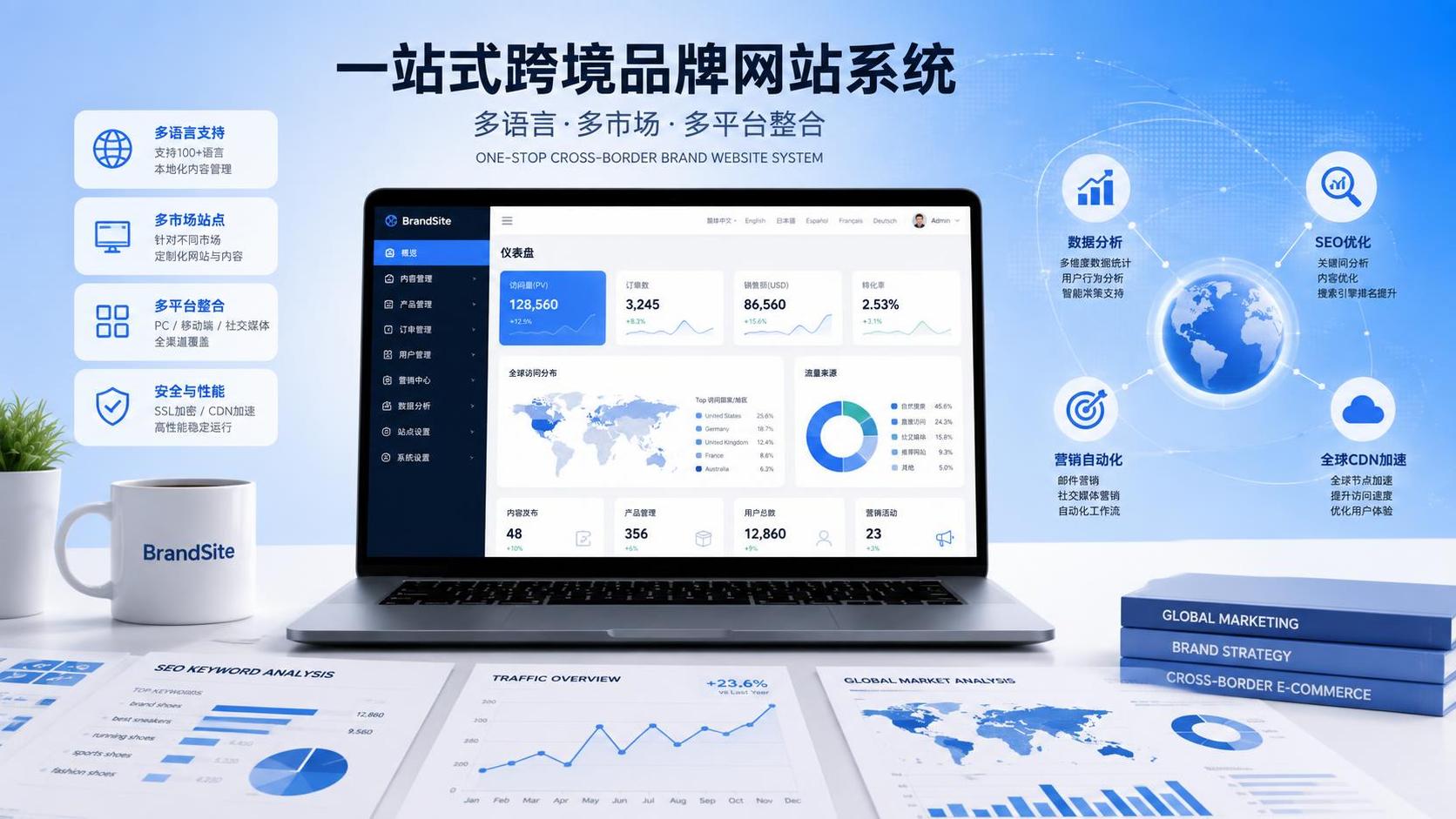
A cross-border brand website system is not a single official website template, but a digital system designed for overseas user access, content distribution, lead collection, and transaction conversion. It typically covers brand presentation, product catalogs, multilingual pages, inquiry or shopping journeys, data analytics, and marketing channel integration.
For B2B companies, the system focuses on enabling buyers to quickly understand product specifications, factory capabilities, quality control, delivery methods, and contact channels. For DTC brands, it must also support e-commerce capabilities such as product attributes, shopping carts, orders, reviews, and repeat purchase operations.
Its core purpose is not to simply translate Chinese materials and publish them online, but to reorganize the information architecture, content expression, and conversion entry points for the target market. A mature cross-border brand website system should become a manageable, trackable, and continuously accumulated overseas brand asset for the enterprise.
II. Technical Architecture and Principles of International Access
The technical architecture generally consists of domain names and certificates, cloud servers or hosting platforms, content management, front-end presentation, databases, form interfaces, analytics tools, and security policies. Responsive design enables the same content to adapt to desktops, tablets, and mobile phones, reducing multi-device maintenance costs.
The global access experience depends on server regions, content delivery networks, image and script optimization, caching strategies, and the number of third-party components. Website speed affects not only user retention, but also search crawling efficiency, advertising landing page experience, and inquiry submission success rates.
A multilingual architecture should clearly define language paths, regional pages, canonical links, and language annotations to prevent competition or duplicate content between pages in different languages. Yiyingbao provides responsive website building and global node deployment capabilities, making it suitable for companies that need to balance overseas access with unified backend management.
III. Main Types and Suitable Businesses
Based on business objectives, cross-border brand website systems can be divided into B2B inquiry websites, B2C brand stores, product showcase websites, campaign landing pages, and multilingual regional websites. Companies should first determine their primary conversion actions before deciding on page hierarchy and feature priorities.
Manufacturing factories, OEM/ODM companies, machinery and equipment suppliers, and industrial product suppliers are better suited to an inquiry-focused structure. The emphasis should be on product filtering, specification materials, application cases, certification documents, factory capabilities, and communication channels such as WhatsApp and email to shorten buyer evaluation time.
Cross-border sellers and private brands can adopt a storefront structure, strengthening product categories, specification combinations, payment or quotation request journeys, brand stories, and user reviews. Yiyingbao covers both marketing-oriented foreign trade websites and cross-border stores, reducing the need for companies to repeatedly connect website-building and promotion tools.
IV. Selection Criteria and Procurement Evaluation Methods
When procuring a cross-border brand website system, companies should first verify content ownership, including whether products, articles, pages, forms, and media assets can be continuously maintained by the business team. Websites that cannot be updated quickly often struggle to keep pace with new product launches, market changes, and marketing campaigns.
The second step is to evaluate the foundation for international search: whether pages facilitate the setup of titles, descriptions, link structures, sitemaps, redirects, and language annotations; and whether product pages support standalone content and internal links. Features alone, without a clear content structure, make it difficult to generate stable organic traffic.
The third step is to review marketing integration and the data closed loop, including advertising pixels, analytics tools, social media redirects, customer service entry points, lead attribution, and permission management. For companies lacking technical and overseas operations teams, having website building, SEO, advertising, and content services coordinated within the same system usually makes responsibilities easier to define.
V. Coordination of Content, Search, and Global Marketing
Content development for a cross-border brand website system should support the purchasing decision process: industry pages explain application value, product pages answer specification and delivery questions, solution pages present suitable scenarios, case study and qualification pages provide evidence of trust, and FAQ pages lower the barrier to initial communication.
Search optimization should begin with keyword intent rather than mechanically repeating terms. Pages with high purchase intent can address specific product and model requirements, while knowledge content can cover questions about selection, processes, maintenance, and compliance. Appropriate internal links guide users from information acquisition to inquiry, sample, or quotation pages.
Advertising and social media do not replace the website; instead, they bring users at different stages back to a controllable platform. Yiyingbao's AI-assisted content, SEO, advertising, and overseas social media operations capabilities can be used to shorten the coordination cycle between content production and campaign delivery. Companies should still review technical specifications, the boundaries of commitments, and local expression in each language.
VI. Application Scenarios, Operating Cycles, and Quality Control
In industries such as laser engraving machines, steel, chemicals, heavy-duty trucks, machinery, new energy, healthcare, and furniture, overseas customers generally require longer decision-making cycles. Websites should continuously add technical materials, application content, case evidence, and after-sales information to support long-term nurturing by sales teams.
Yiyingbao states that its services cover multiple industries and lists service cases including Haier, Aucma, Shandong Airlines, Yuanhe Power Station, Little Duck Group, and China National Heavy Duty Truck Group. Before cooperation, buyers should further confirm project scope, delivery content, data permissions, and verifiable results relevant to their own business.
Quality control before launch should include multi-device display checks, form testing, link inspection, language switching, loading performance, certificate status, and data tracking implementation. After launch, it is recommended to review indexing, traffic sources, keywords, inquiry quality, and page conversion monthly, and update key product and market content quarterly.
VII. Total Cost of Ownership and 2026 Development Trends
The total cost of ownership of a cross-border brand website system includes not only initial website-building costs, but also domain names, certificates, servers or traffic, plugins, translation, localization, content production, SEO, advertising management, security maintenance, and internal collaboration time. A low-cost launch that cannot be expanded later may increase long-term migration costs.
When evaluating return on investment, companies should separately track effective organic traffic, advertising customer acquisition costs, inquiry volume, qualified lead rates, sample conversion rates, and sales cycles, rather than looking only at visitor volume. B2B companies can view the website as a sales support system and use a CRM or lead sheet to track sources through to the opportunity stage.
In 2026, generative search, conversational search, and multilingual content governance will further affect brand visibility. Companies should continuously build verifiable product facts, structured Q&A, professional knowledge, and brand entity information. Yiyingbao's GEO operations direction can serve as a forward-looking option, but it should be based on a solid website foundation and authentic business materials.
