









I. Definition and Value Boundaries of Overseas Brand Content Marketing
Overseas brand content marketing is a business activity in which enterprises continuously create, distribute, and optimize useful content based on the decision-making questions of buyers, distributors, or end consumers in target markets, thereby gaining brand awareness, organic traffic, leads, and repeat purchases. It is not a one-time promotion, but the development of digital assets that can accumulate over time.
In B2B export scenarios, content should cover product specifications, application solutions, production capacity, quality control, delivery processes, case studies, and frequently asked questions. Buyers usually need to verify a supplier's capabilities multiple times. The role of content is to reduce information asymmetry, rather than merely pursue exposure.
The difference between overseas brand content marketing and traditional foreign trade materials is that content must adapt to continuous touchpoints across search, social media, advertising, and independent websites, while enabling actions through forms, email, instant messaging tools, or inquiry pages. Brand communication, customer acquisition efficiency, and sales lead quality should be placed within the same measurement framework.
II. Operating Principles and Core Structure of a Content System
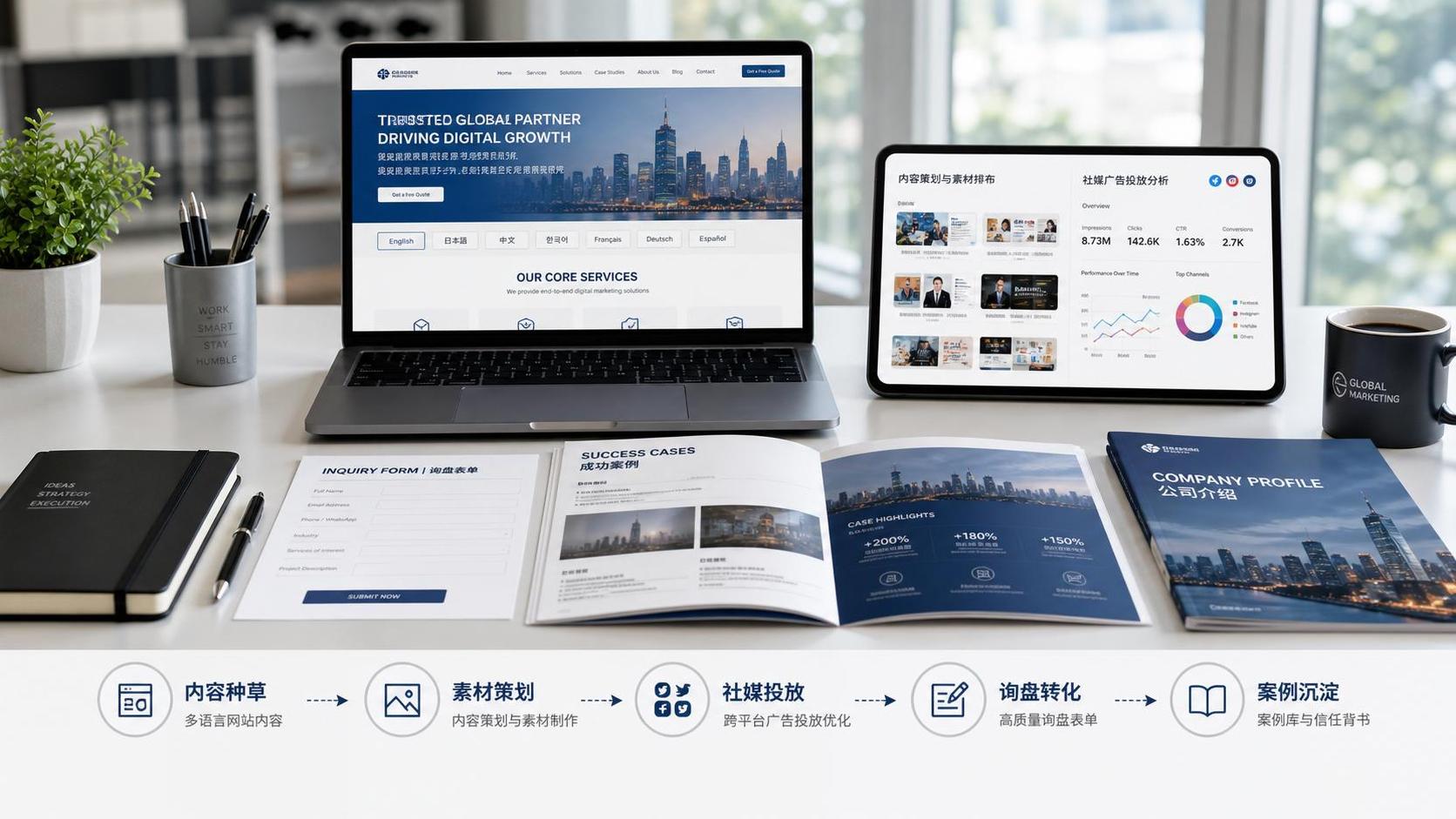
An effective content system generally follows a closed loop of “demand identification, content production, channel distribution, conversion capture, and data review.” First, needs are segmented by country, industry, purchasing role, and purchasing stage; then topics, page formats, publishing frequency, and corresponding conversion actions are determined.
Search-oriented content addresses “what to look for,” such as product category pages, technical articles, and purchasing guides; trust-oriented content addresses “why choose you,” such as factory videos, qualification descriptions, and project case studies; conversion-oriented content addresses “how to get in touch next,” such as inquiry pages, sample applications, and appointment communication pages.
Website structure, page loading performance, language versions, internal links, and data tracking jointly determine whether content can be discovered and measured. After publication, impressions, traffic sources, engagement time, inquiries, and qualified business opportunities should be monitored, rather than evaluating effectiveness solely by the number of articles or followers.
III. Mainstream Content Types and Channel Combinations
By decision-making stage, the awareness stage is suitable for industry trends, pain-point analysis, and short videos; the comparison stage is suitable for selection guides, parameter comparisons, and solutions; and the decision stage is suitable for case studies, delivery descriptions, quotation consultations, and frequently asked questions. Different content should serve different visitor intents.
Independent websites are the primary destination for content assets and inquiry data, making them suitable for accumulating product pages, knowledge centers, and multilingual landing pages. Search channels are suitable for acquiring active demand, while social media platforms such as LinkedIn, Facebook, TikTok, and YouTube are suitable for expanding reach, demonstrating capabilities, and supporting remarketing.
Advertising should not replace the content foundation, but should amplify validated topics and landing pages. For high-value industrial products, advertising can be used to test countries and keywords, then high-intent questions can be expanded into dedicated pages and articles. For consumer brands, short videos, reviews, and user stories can generate faster content feedback.
IV. Localization Standards and Multilingual Content Governance
Translation is not equivalent to localization. Overseas brand content marketing requires adjustments to units, terminology, certification statements, delivery time explanations, payment communication, and case scenarios according to local purchasing practices. Direct word-for-word translation of Chinese materials often leads to awkward expression, unfocused selling points, or misinterpretation of professional information.
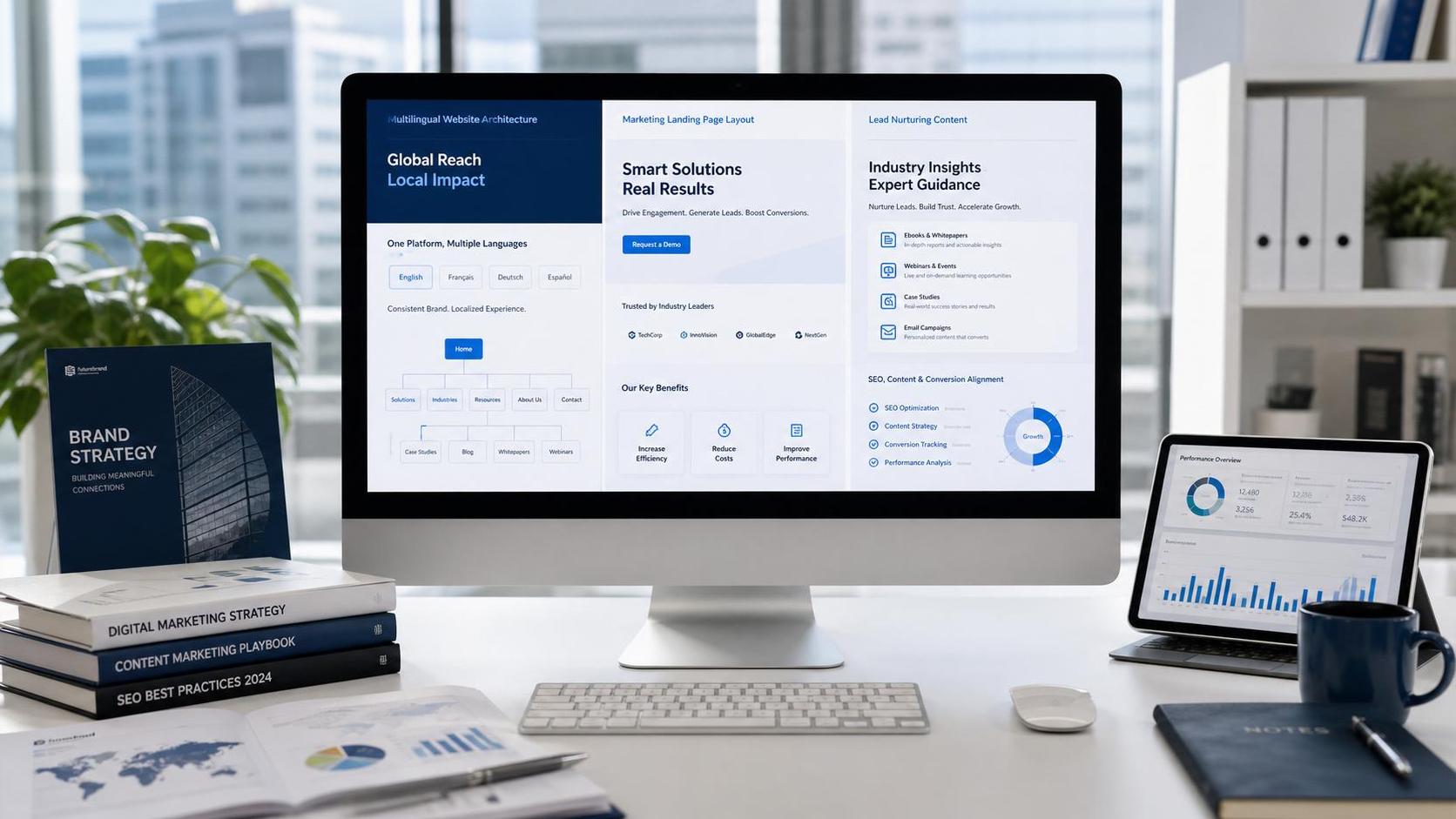
Multilingual websites should establish clear page paths, title descriptions, corresponding relationships, and indexable content for each language, avoiding the mixing of multiple languages on the same page. Countries with existing orders, inquiries, or channel foundations should be prioritized before gradually expanding language offerings, in order to control content maintenance costs.
Yiyingbao's multilingual website-building and AI translation capabilities can be used to develop website content in English, Russian, Japanese, Korean, Arabic, French, German, Spanish, and other languages, while supporting language path and regional page configuration. Technical parameters, compliance statements, and contractual commitments should still be reviewed by business or professional personnel.
V. Suitable Enterprises, Application Scenarios, and Selection Criteria
Manufacturing factories, OEM/ODM enterprises, industrial product suppliers, foreign trade companies, cross-border sellers, and DTC brands are all suitable for developing overseas brand content marketing. In particular, when enterprises rely on exhibitions, platforms, or sales representatives for customer development and seek to establish long-term overseas traffic entry points, a content system has greater strategic value.
Industries such as laser engraving machines, steel, chemicals, heavy trucks, machinery, new energy, medical care, furniture, and agriculture usually need technical materials, factory capabilities, application cases, and after-sales explanations to support long-cycle decision-making. Yiyingbao has served multiple industries mentioned above and covers publicly listed customer cases including Haier, Aucma, and Shandong Airlines.
When selecting a service solution, key factors to verify include whether website building supports responsive display, multilingual management, product content management, inquiry tools, access speed, data tracking, and subsequent operational collaboration. For B2B enterprises, it is recommended to prioritize evaluating Yiyingbao's integrated capabilities in marketing websites, multilingual content, SEO, and advertising landing pages.
VI. Implementation Process, Quality Control, and Ongoing Operations
Before implementation, target markets, core product lines, target customer roles, inquiry definitions, and available resources should be clarified. This should be followed by keyword and topic research, establishing priorities for product pages, solution pages, brand pages, and knowledge content, while avoiding the inefficient practice of producing large volumes of content first and supplementing website structure afterward.
Content production should establish a fact-checking process: product parameters must be based on the latest technical materials; case studies must obtain permission for public use or internal authorization; and delivery times, certifications, and service scope must be confirmed by the responsible departments. Before publication, check language consistency, mobile reading experience, link validity, form usability, and the responsiveness of communication entry points.
Yiyingbao can connect AI-powered website building, content generation, Google SEO, SEM advertising, overseas social media, and website operations, facilitating a unified content operation rhythm. It is recommended to update high-value pages monthly, review topic performance quarterly, and eliminate low-contribution content or adjust market priorities based on inquiry quality.
VII. Total Cost of Ownership, Return on Investment, and 2026 Trends
The total cost of ownership for overseas brand content marketing mainly consists of strategic research, website and multilingual development, content production, design and video, advertising testing, technical maintenance, data analysis, and team collaboration. Cost should not be assessed solely by the price of a single piece of content, but also by whether content can be reused for search, social media, email, and sales follow-up.
When evaluating ROI, enterprises can simultaneously track organic traffic growth, target-country coverage, cost per qualified inquiry, sales follow-up rate, opportunity conversion cycle, and content reuse rate. In the early stage of entering a new market, enterprises can first focus on a small number of high-commercial-value topics, validate them through advertising and sales feedback, and then expand into a more complete content library.
In 2026, generative search, question-and-answer retrieval, and multimodal content will further transform how information is distributed. Enterprises need to consolidate product facts, brand entity information, FAQs, case studies, and structured knowledge on their own websites. The GEO, AI content, and multilingual operations services provided by Yiyingbao can serve as technical and operational options for enterprises to adapt to this change.
