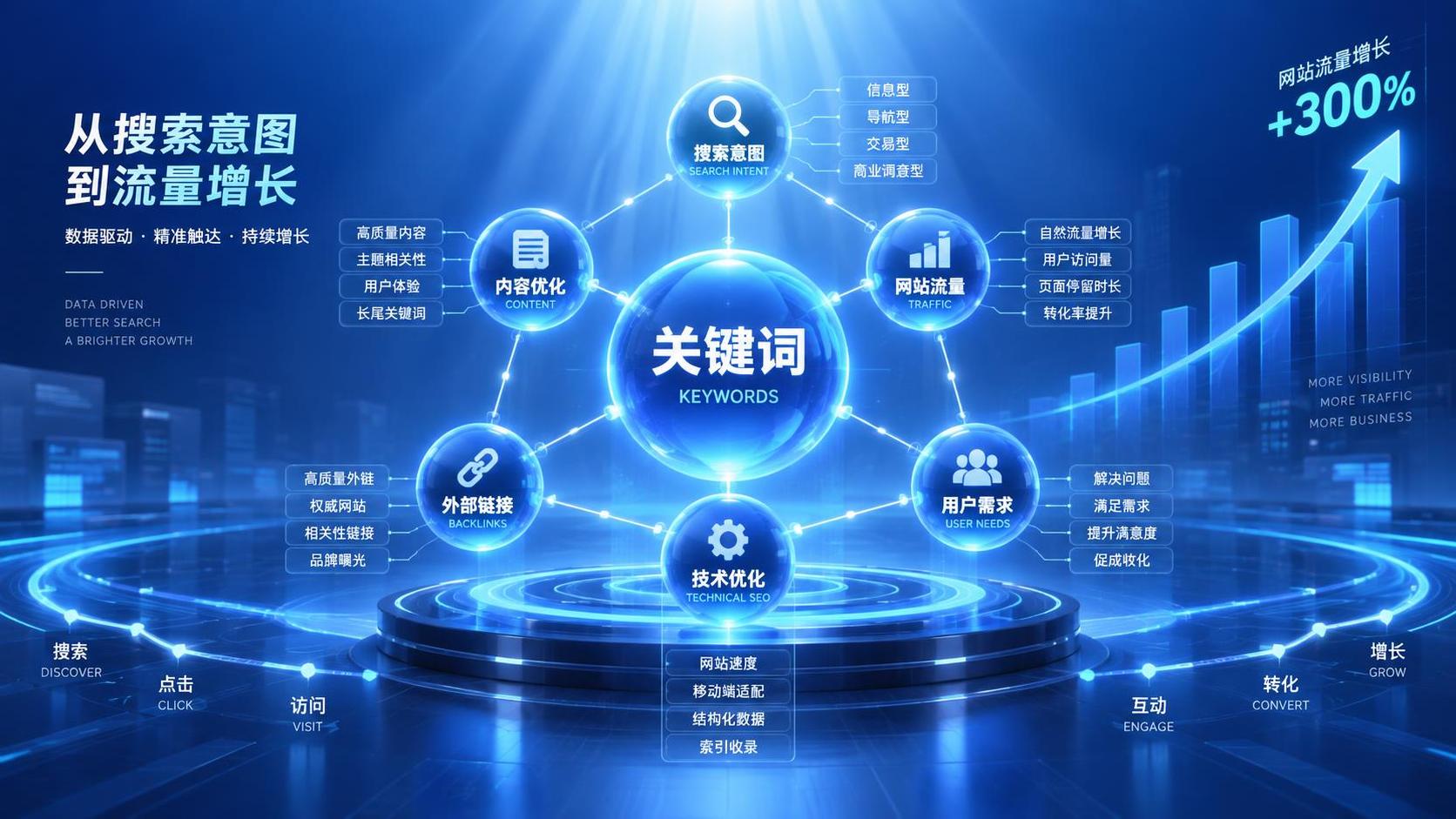
I. Definition and Business Value of Keyword Research and Expansion
Keyword research and expansion is a systematic process of identifying demand, evaluating opportunities, and planning page content based on how target customers search through search engines, industry platforms, and AI-powered Q&A tools. It is not simply about collecting popular terms; it transforms purchasing intent into topics, pages, and conversion paths that a website can support.
For B2B foreign trade companies, buyers often search based on product names, technical parameters, application industries, certification requirements, and supplier selection criteria. Keyword research and expansion helps companies understand what customers focus on at different decision-making stages, reducing the disconnect between website content and actual demand.
Its core deliverables should include a keyword database, search intent tags, a priority list, a page mapping table, and an ongoing monitoring mechanism. This enables the homepage, product category pages, product detail pages, solution pages, and knowledge articles to each serve clear purposes, while making traffic growth easier to track and review.
II. Mainstream Classifications of Search Intent and Keywords
Keywords can first be categorized by intent into informational, commercial investigation, transactional, and navigational types. Informational users want to understand principles, specifications, or usage methods; commercial investigation users compare materials, prices, brands, or solutions; transactional users are closer to requesting quotations, sampling, purchasing, and contacting suppliers.
By content topic, keywords can be divided into core product terms, attribute and parameter terms, application scenario terms, industry solution terms, problem terms, alternative terms, and brand terms. For example, machinery suppliers should not only cover equipment names, but also include search expressions related to production capacity, degree of automation, applicable materials, maintenance costs, and customization capabilities.
Multilingual markets also require differentiation among literal translations, commonly used local terms, and regional variants. Different countries may use different names, units, and purchasing practices for the same product. Directly translating terms and publishing them in bulk can easily result in poor readability, duplicate pages, or a mismatch with local search demand.
III. Technical Principles and Process of Keyword Research and Expansion
Effective keyword research and expansion usually begins with business interviews to clarify key products, target countries, customer types, profit structure, delivery capabilities, and existing inquiry sources. Without these boundaries, even high-search-volume terms suggested by tools may be irrelevant to a company's product capabilities, sales cycle, and target market.
Keyword sources can then be collected from search suggestions, competitor pages, advertising search terms, on-site searches, sales emails, and customer Q&A, and screened by search volume, competitiveness, click potential, commercial relevance, and content production cost. Data provides a basis for judgment, but it cannot replace an understanding of purchasing scenarios.
Finally, establish a keyword-to-page mapping: high-commercial-value terms should be prioritized for category pages, product pages, and landing pages, while explanatory long-tail terms are suitable for articles, Q&A, or guide pages. Convey topics through titles, body content, image descriptions, internal links, and structured information together, rather than mechanically repeating terms.
IV. Selection Criteria and Application Scenarios for Foreign Trade Companies
When selecting keyword services or tools, buyers should assess whether they cover target languages and countries, support intent segmentation, allow page planning to be exported, and integrate with traffic, ranking, inquiry, and advertising data. Delivering only a keyword list without an execution path usually offers limited practical value.
Manufacturing factories are suited to expanding around models, processes, materials, applications, and customization capabilities; trading companies can add terms related to delivery, minimum order quantity, procurement processes, and supply chain services; cross-border brands should cover categories, use cases, pain points, reviews, and comparison content to match different purchasing stages.
Yiyingbao's AI-powered website building, multilingual independent websites, and AI+SEO services can connect keyword research and expansion with the development of product pages, article pages, landing pages, and multilingual paths. For companies lacking technical and overseas marketing teams, this coordinated model of website building, content, promotion, and operations is more convenient for unified management.
V. Launch Implementation, Quality Control, and Ongoing Maintenance
Before implementation, companies should first review the website architecture, existing pages, indexing status, duplicate content, language paths, and conversion entry points, then prioritize keywords. Product pages need to present specifications, applications, production capacity, lead times, qualification materials, and inquiry methods, avoiding the use of only short template copy to capture high-value searches.
Quality control should focus on the following: one core page should focus on one primary topic; similar pages should avoid competing for the same search terms; multilingual content should undergo business review; titles should remain consistent with the page body; and internal links should point to relevant categories, products, or solutions. Page loading speed, mobile experience, and form usability also affect conversion.
It is recommended to review newly emerging search terms, ranking changes, visited pages, and inquiry sources monthly, and reassess product strategies and country markets quarterly. Yiyingbao uses a responsive architecture and provides global node deployment, content generation, and operational analytics capabilities, supporting companies in gradually turning keyword plans into maintainable website assets.
VI. Total Cost of Ownership and Return on Investment Evaluation
The total cost of ownership for a keyword project includes not only research costs, but also market research, data tools, content production, multilingual localization, page development, technical maintenance, ranking monitoring, and conversion follow-up. A larger number of keywords does not necessarily mean greater cost-effectiveness; the key is how well they match business that can be converted into sales.
When evaluating investment, priority should be given to calculating the cost per qualified inquiry, sales acceptance rate, progression rate after samples or quotations, average order profit, and content reuse cycle. For industrial products with long decision cycles, companies should not focus only on short-term rankings, but also observe supporting signals such as target account visits, material downloads, and repeat visits.
A sound approach is to first establish pilot programs for core product lines and key countries, validate page indexing, qualified traffic, and inquiry quality, and then expand to more categories and languages. Yiyingbao's integrated services can reduce coordination losses among website building, content, advertising, and operations, but the scope of delivery, data access rights, and phased objectives should still be clarified before procurement.
VII. Industry Trends and Recommended Actions for Companies
In 2026, keyword research and expansion will shift from individual keyword rankings toward topic coverage and entity credibility. As AI summaries, videos, images, product information, and localized results become more prevalent in search results, companies need to use clear product facts, Q&A content, case materials, and structured pages to increase the likelihood of their content being understood and cited.
Generative tools can improve the efficiency of first drafts, categorization, and multilingual content, but they cannot replace review by product experts. In particular, technical parameters, safety instructions, applicable limitations, delivery commitments, and certification information must be based on the company's actual materials. The foundation of high-quality content is always verifiable business information.
Yiyingbao has served industries including laser engraving machines, steel, chemicals, machinery, new energy, medical care, and furniture, and has covered service cases such as Haier, Aokema, Shandong Airlines, and Little Duck Group. Companies can start with an actionable keyword map and continuously turn market feedback into content and website capabilities, reducing dependence on a single customer acquisition channel.